
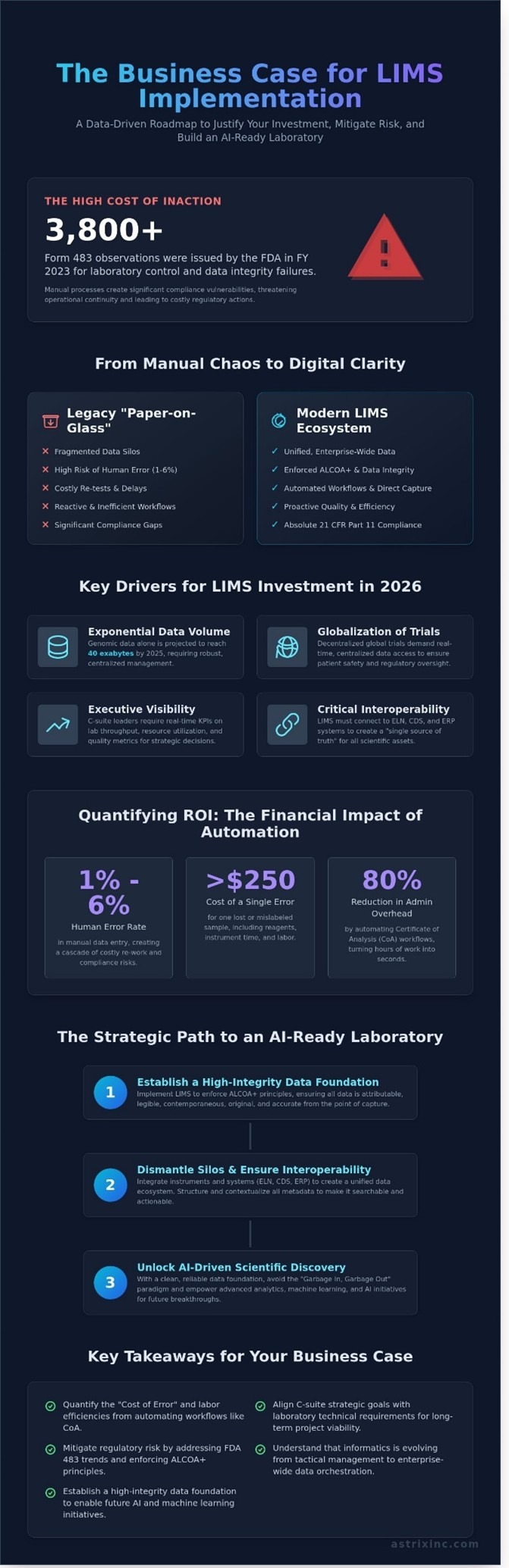
In fiscal year 2023, the FDA issued more than 3,800 Form 483 observations, many tied to laboratory controls and data integrity gaps. For life sciences organizations still dependent on manual processes, these risks are operational—not theoretical. Fragmented data silos, repeat testing, and inefficient workflows continue to erode budgets, while securing executive buy-in for 2026 investments remains challenging. Building a compelling business case for LIMS implementation requires more than listing system features; it demands a clear, data-driven narrative that connects laboratory performance to measurable enterprise value.
This article provides a technical framework to justify your investment through the lenses of quantifiable ROI and absolute regulatory compliance. We’ll outline a strategic roadmap for achieving a defensible return while ensuring your Scientific & Laboratory Informatics ecosystem meets the rigorous standards of 21 CFR Part 11. You’ll learn how to transition your facility from a reactive state to an AI-ready environment using an end-to-end digital strategy. We’ll examine the specific methodologies for dismantling silos and establishing the interoperability required for future-proof scientific discovery.
Key Takeaways
- Understand the evolution of laboratory informatics from localized tactical management to a unified, enterprise-wide strategy for scientific data orchestration.
- Quantify the financial impact of digital transformation by analyzing the “Cost of Data-Related Error” and identifying labor efficiencies gained through the automation of complex Certificate of Analysis (CoA) workflows.
- Mitigate significant regulatory risk by developing a robust business case for LIMS implementation that enforces ALCOA+ principles and directly addresses the increasing scrutiny of FDA 483 trends.
- Establish a high-integrity data foundation for future-ready AI initiatives by ensuring all laboratory metadata is structured, contextualized, and free from the downstream impacts of poor-quality inputs.
- Navigate the complexities of stakeholder alignment by synchronizing C-suite strategic goals with the technical requirements of laboratory management to ensure long-term project viability.
The Strategic Necessity of LIMS in the Highly Regulated Life Sciences Landscape
Developing a compelling business case for LIMS implementation is not simply a budgeting exercise. It is a strategic blueprint for an organization’s digital transformation. Across the life sciences sector, laboratories are moving from tactical, task‑based management toward enterprise‑level orchestration of scientific data, a shift driven by rising regulatory expectations and the operational demands of modern R&D and manufacturing. The laboratory environment now operates under unprecedented data complexity. The Tufts Center for the Study of Drug Development estimates that bringing a new drug to market can cost more than $2.6 billion, placing intense pressure on organizations to accelerate discovery, reduce variability, and improve operational efficiency. Achieving these outcomes requires a modern informatics foundation that ensures data integrity, supports automation, and enables scalable scientific operations.
A comprehensive Laboratory Information Management System (LIMS) provides the technical backbone for this transition. It moves the organization away from siloed data toward a unified digital ecosystem. Continuing to rely on legacy processes is not a neutral choice. It sustains an operating model with escalating cost and compliance exposure. This inertia perpetuates fragmented data, increases the likelihood of human error, and introduces avoidable regulatory friction. Under 21 CFR Part 11, laboratories must ensure the integrity, reliability, and consistency of electronic records. Without a modern informatics platform to automate these controls, organizations face elevated compliance vulnerabilities that can delay product releases or result in costly enforcement actions.
The Evolution of Laboratory Informatics
The industry has moved beyond digital systems that mimic legacy paper workflows and now expects tools that meaningfully improve how laboratory work is performed. Modern informatics emphasizes integrated, vendor‑agnostic ecosystems aligned with the Lab of the Future (LoTF) concept, enabling seamless data exchange across instruments, analytical systems, and stakeholders. In this model, Scientific & Laboratory Informatics serves as an enabler of scientific discovery, providing the infrastructure that supports speed, consistency, and data integrity across R&D and QC. Astrix helps organizations realize this model by ensuring that technology never constrains science. Through vendor‑agnostic guidance and architecture‑first design, Astrix develops informatics environments that maintain end‑to‑end data integrity today while remaining adaptable to emerging methods and future innovations.
Key Drivers for LIMS Investment in 2026
Several critical factors are making the business case for LIMS implementation urgent for 2026. Scientific data volumes continue to grow exponentially, and multi‑omics workflows are producing dense, high‑dimensional datasets that require structured storage and sophisticated metadata to remain searchable, interoperable, and analytically useful. These pressures are reshaping what labs expect from their informatics backbone. The primary drivers are clear:
- Data Volume: NIH projections estimated that genomic data alone would reach about 40 exabytes per year by 2025. By 2026, that scale is evident across research environments, making centralized, resilient data management essential.
- Globalization: Clinical trials are increasingly decentralized and global. This requires real-time, centralized data access to maintain oversight and ensure patient safety across different regulatory jurisdictions.
- Executive Visibility: C‑suite leaders expect clear, timely insight into laboratory operations. They rely on indicators of throughput, resource use, and quality performance to inform planning and investment decisions.
- Interoperability: The need for LIMS to communicate directly with ELN, CDS, and ERP systems is essential for establishing a “single source of truth” for all scientific data assets.
The cost of maintaining the status quo is measurable in lost time and diminished competitive advantage. Organizations that invest in a structured informatics strategy today are better positioned to lead the next wave of scientific breakthroughs. A successful LIMS strategy isn’t just about software; it’s about building a foundation for sustainable, data-driven innovation.
Quantifying ROI: Efficiency Gains and Operational Cost Reduction
Building a robust business case for LIMS implementation requires a clear assessment of how digital transformation reduces the hidden costs embedded in inefficient, disconnected processes. The ROI of a LIMS is not defined solely by software features. It is realized through the systematic elimination of operational friction across the scientific lifecycle.
Manual transcription remains a significant liability for modern laboratories. Research indicates that human error rates in manual data entry range from 1% to 6%, creating hidden costs embedded in retesting, investigation effort, and the risk of regulatory non‑compliance. In high-volume environments, the cost of a single lost or mislabeled sample can exceed $250, including reagents, instrument time, and labor. By enforcing direct instrument‑to‑system data capture, a LIMS creates a protective layer that preserves the integrity of the scientific record.
Direct labor savings represent the most immediate impact on the balance sheet. Automating the Certificate of Analysis (CoA) workflow can reduce administrative overhead by up to 80%, transforming a process that once took hours of manual collation into a task completed in seconds. This optimization allows for increased throughput without proportional staffing increases. Statistics from the life sciences sector show that labs utilizing automated informatics often experience a 25% increase in sample capacity. This scalability is essential for organizations looking to grow their testing volume while maintaining a lean operational profile. Strategic planning through scientific informatics consulting ensures these ROI targets are accurately forecasted and met.
Resource allocation is perhaps the most undervalued component of the financial argument. In many traditional labs, high‑value PhD‑level scientists spend 30% to 40% of their time on administrative data management rather than on experimental design, analysis, or interpretation. A LIMS redirects this expertise toward innovation by automating routine documentation and eliminating manual data handling. When senior scientific talent is freed from low‑value tasks, the organization maximizes its investment in intellectual capital and accelerates the pace of discovery, validation, and decision‑making.
The Financial Impact of Laboratory Automation
Benchmarking time savings shows that LIMS integration typically reduces data review cycles by 40% to 60%. This acceleration is driven by automated alerts and real-time status tracking, which eliminate the “dead time” between testing and approval. Inventory management offers another avenue for cost reduction; automated tracking of reagents and consumables can reduce waste by approximately 12% by preventing the expiration of materials. The true value of the system lies in its interoperability. Connecting LIMS with ELN, ERP, and chromatography systems creates a unified data thread that is central to the evolution of LIMS as a holistic scientific ecosystem. This connectivity ensures that data flows seamlessly across the enterprise, reducing the need for manual reconciliation.
Tangible vs. Intangible Benefits
While direct cost savings are quantifiable, intangible benefits often drive long-term competitive advantage. For pharmaceutical R&D labs, “Speed to Market” is a critical metric. Accelerating a product launch by even 30 days can result in millions of dollars in additional revenue. Compliance with 21 CFR Part 11 is another non-negotiable benefit. Automated audit trails and electronic signatures reduce the risk of regulatory findings, protecting the organization from the financial and reputational damage associated with warnings, delays, or recalls. When tedious manual tasks are automated, the administrative burden decreases and retention improves, protecting the organization’s most valuable asset—its scientific talent.
The Regulatory Mandate: Risk Mitigation and Data Integrity
The financial impact of non-compliance in the life sciences sector reached new levels in 2023. FDA data shows that laboratory record-keeping violations under 21 CFR 211.194(a) remain among the top three most frequent inspection observations. A single Warning Letter can trigger a double-digit decline in share value and require millions in remediation costs. A LIMS is not a discretionary software purchase; it is core defensive infrastructure. By enforcing ALCOA+ principles, a LIMS ensures that data is attributable, legible, contemporaneous, original, and accurate across its lifecycle. In practice, this means that every result is traceable to a user, timestamp, and method, reducing ambiguity during audits and inspections. These controls are not optional; they represent the baseline for operating in regulated environments.
Modern informatics platforms embed 21 CFR Part 11 and Annex 11 requirements directly into routine laboratory operations. Time‑stamped audit trails, secure electronic signatures, and controlled access prevent unauthorized data modification and create a continuous chain of custody for every result. Manual or paper‑based systems cannot deliver this level of oversight or traceability. Automated, searchable compliance reports transform audit preparation from weeks of manual document gathering into minutes of digital retrieval, reducing both inspection risk and operational disruption. Organizations that continue to rely on manual processes face significantly higher exposure to data‑integrity findings during routine inspections, especially as regulators intensify scrutiny of record completeness, attribution, and system controls.
Securing the Digital Thread
A robust business case for LIMS implementation relies on modern Computer System Validation (CSV). We apply a risk-based validation approach, following GAMP 5 guidelines, to focus testing on high-impact functions. This strategy reduces validation timelines by 30% while maintaining absolute compliance. Audit trails create an immutable history of every sample, result, and modification. This transparency eliminates the “data silos” that often hide critical errors during regulatory reviews. Scientific & Laboratory Informatics solutions must bridge the gap between raw data and actionable, compliant insights. By establishing a digital thread, laboratories can trace a result back to the specific reagent batch and technician involved, providing a level of granularity that paper records can’t achieve.
Regulatory and Financial Risk Shielding
The cost of a product recall often exceeds $10 million in direct expenses. According to the 2023 Sedgwick State of the Nation Recall Index, U.S. recall activity reached a 19‑year high, with pharmaceutical products among the most frequently impacted categories. LIMS functions as a financial safeguard by identifying out‑of‑specification results before products advance to distribution. It also protects intellectual property through secure, time‑stamped records that establish invention timelines in patent disputes. By supporting global standards such as ISO 17025, GLP, and GMP within a unified platform, LIMS reduces the operational complexity of maintaining multiple compliance frameworks. Quantifying these avoided costs is essential when building a compelling business case for LIMS implementation.
Future-Proofing: LIMS as the Foundation for AI and ML
The effectiveness of scientific AI depends entirely on the integrity and structure of the data used to train and validate its models. Machine learning systems routinely fail when the underlying information is fragmented, inconsistent, or stripped of experimental context. A modern LIMS prevents this by standardizing data capture and embedding high‑context metadata directly into the workflow. This creates the labeled, high‑fidelity datasets that AI systems require to generate reliable insights, detect subtle patterns in biological or chemical interactions, and support reproducible scientific decision‑making.
Data volumes in the life sciences are expanding at an unprecedented rate. The International Data Corporation (IDC) projects that global healthcare data will exceed 10,000 exabytes by 2025, growing at a compound annual rate of approximately 36%, with genomics among the fastest-growing contributors. Managing this influx requires an informatics stack built on FAIR principles. When data is Findable, Accessible, Interoperable, and Reusable, it becomes a strategic asset rather than a storage burden. A strong business case for LIMS implementation highlights how these systems ensure compliance with 21 CFR Part 11, maintain data integrity, and provide traceability throughout the entire lifecycle. By adhering to ALCOA+ principles (Attributable, Legible, Contemporaneous, Original, Accurate, Complete, Consistent, Enduring, and Available), laboratories create a reliable foundation for future digital transformation.
Interoperability is the structural requirement that enables this foundation to function as a unified system. It’s not enough to store data; it must move cleanly between ELNs, CDS, and downstream analytical platforms without manual intervention. Automated data capture eliminates transcription errors, which account for a substantial share of data‑quality issues in paper‑based or legacy environments. By resolving these discrepancies at the point of origin, the LIMS ensures that the datasets feeding AI models are both representative and reliable.
Building a Data Strategy for 2026
A modern LIMS establishes a consistent data foundation for all downstream analytical systems, enabling data to flow reliably into modeling, visualization, and decision-support tools. This unified foundation supports the shift from descriptive analytics, which simply report past events, to predictive and prescriptive modeling that anticipates outcomes and guides experimental decisions. AI readiness has become a core requirement for life‑science capital investment, not an optional enhancement. A 2023 Gartner study found that 80% of life science leaders identify poor data quality as the primary barrier to successful AI adoption, underscoring the need for structured, high‑fidelity data pipelines. By centralizing data and metadata, organizations prepare for a future where predictive insights drive R&D. This forward-looking approach is a mandatory component of any modern business case for LIMS implementation.
Strategic Consulting and Long-Term Value
Selecting a scalable system requires vendor‑agnostic guidance to preserve long‑term flexibility and avoid proprietary data silos. Astrix incorporates AI and machine‑learning readiness into the initial implementation roadmap, preventing the emergence of rigid architectures that cannot evolve with scientific or regulatory demands. For example, one global biotech organization reported a 18% reduction in its lead-optimization cycle after using structured LIMS data to train its discovery algorithms, demonstrating how aligned informatics foundations accelerate scientific outcomes. This strategic approach ensures that the informatics investment continues to deliver value well beyond the initial go‑live. Astrix consultants prioritize the science of the laboratory, ensuring that technology supports discovery rather than constraining it.
Learn how our experts can help you design an informatics roadmap that supports your future AI initiatives.
Explore Astrix Strategic Consulting Services
Architecting the Business Case: A Stakeholder-Centric Approach
A successful business case for LIMS implementation depends on more than technical specifications; it requires a strategic alignment of priorities across the C‑suite, IT leadership, and laboratory operations. Laboratory managers focus on reducing error rates commonly associated with manual data entry, while Chief Information Officers prioritize enterprise architecture, interoperability, and data security. When these perspectives converge, the platform is no longer viewed as a localized laboratory tool but as a core component of the organization’s digital infrastructure. This alignment reduces the risk of isolated initiatives—one of the primary contributors to the high failure rates Gartner associates with digital‑transformation programs that lack clear stakeholder consensus and cross‑functional support.
Quantifying the Total Cost of Ownership (TCO) relative to a projected Return on Investment (ROI) remains the most critical hurdle to project approval. TCO must account for initial licensing, cloud infrastructure, continuous validation required by rigorous regulatory frameworks, long-term maintenance, and user training costs. Conversely, the ROI is realized through measurable gains such as a 15% increase in laboratory productivity and the mitigation of non-compliance risks that could lead to costly warning letters. A phased roadmap facilitates these outcomes by delivering “quick wins,” such as automating high-volume sample logging within the first 120 days of the project. This incremental delivery builds organizational confidence and provides tangible data points to justify the ongoing investment throughout the system’s multi-year lifecycle.
Securing Executive Buy-In
Executives evaluate laboratory informatics in terms of risk reduction and competitive advantage. Positioning the LIMS as a strategic enabler clarifies how centralized, high‑integrity data supports 21 CFR Part 11 compliance and accelerates the path to market for new therapies. To counter the persistent concern around implementation failure, organizations need proven, vendor‑agnostic methodologies that bridge scientific requirements with technical execution. Engaging specialized external expertise protects internal bandwidth and ensures operational continuity throughout system integration. This approach reframes the initiative from a cost center into a documented driver of operational excellence, strengthening confidence in both the investment and the long‑term informatics strategy.
The Astrix Advantage in LIMS Delivery
Astrix brings more than 25 years of specialized life‑science informatics experience to developing a defensible business case for your LIMS implementation. Our consultants provide an independent technical perspective that ensures the selected platform supports your scientific and operational priorities. Through end‑to‑end services that span strategic advisory work to highly specialized scientific staffing, we create a clear, coordinated decision framework that aligns technology choices with laboratory workflows, data integrity requirements, and long‑term scalability. This holistic oversight transforms the informatics landscape from a collection of disconnected tools into a unified engine for discovery and regulatory excellence, ensuring your laboratory remains compliant with global standards such as ISO 17025.
Partner with Astrix for your LIMS Transformation
Advancing Your Laboratory’s Digital Maturity
Building a robust business case for LIMS implementation isn’t just about software procurement; it’s about strategically aligning operational efficiency with regulatory adherence. By 2026, laboratories that haven’t digitized face a 25% higher risk of data integrity citations during FDA inspections. Modern systems provide the necessary framework for 21 CFR Part 11 compliance while delivering an average 30% reduction in sample turnaround times. These efficiencies directly impact the bottom line, allowing scientific teams to focus on discovery rather than manual data entry.
Astrix brings more than 25 years of specialized life‑science informatics experience to this transition. We have guided hundreds of global organizations through complex GxP environments with a vendor‑agnostic approach that prioritizes each organization’s scientific objectives. Our team ensures that your informatics strategy not only meets current requirements but also establishes the scalable architecture needed for future AI and ML integrations. The result is a steady, technically credible partner capable of navigating the most intricate digital and regulatory landscapes.
Your path toward a more efficient, compliant, and future-ready laboratory starts with a single strategic decision.
Frequently Asked Questions
What is the typical ROI period for a LIMS implementation in a life sciences lab?
Most life sciences organizations realize a full return on investment within 18 to 36 months of deployment. A comprehensive business case for LIMS implementation often highlights a 25% reduction in data entry errors and a 30% increase in analyst productivity based on 2023 industry benchmarks. These quantitative gains in operational efficiency directly offset initial licensing costs by accelerating the time-to-market for critical therapeutics.
How does LIMS help with 21 CFR Part 11 compliance?
A LIMS enforces compliance with 21 CFR Part 11 by establishing automated audit trails and secure electronic signatures. These technical controls ensure data integrity by preventing unauthorized modifications to records. According to 2024 FDA inspection data, inadequate record-keeping remains a top citation; a validated system successfully mitigates this risk by maintaining a chronological record of all laboratory activities and researcher interactions.
What are the highest hidden costs in a LIMS business case?
Data migration and post-go-live support often account for 40% of the total cost of ownership. Organizations frequently underestimate the resources required for legacy data cleansing and user adoption training. Your business case for LIMS implementation should include a 15% contingency budget for iterative configuration changes. These costs arise during the first 12 months of operation as workflows are refined to improve performance.
Can LIMS really help our lab get ready for AI and Machine Learning?
LIMS serves as the foundational layer for AI by standardizing data formats and ensuring high-quality metadata. A 2023 Deloitte report indicates that 80% of AI initiatives fail because siloed and inconsistent data prevent models from learning effectively. By centralizing information, LIMS provides the structured datasets necessary for machine learning algorithms to identify patterns in drug discovery. This digital maturity is essential for any lab pursuing advanced predictive analytics.
How do we choose between a SaaS LIMS and an on-premise solution?
Choosing between a SaaS LIMS and an on‑premise deployment depends on your IT operating model, data‑governance requirements, and long‑term scalability strategy. SaaS now represents the majority of new LIMS implementations because it offers faster deployment cycles, lower infrastructure overhead, and continuous vendor‑managed updates. On‑premise platforms remain appropriate for organizations with strict data‑sovereignty mandates, highly customized security controls, or existing infrastructure investments that must be leveraged. Each model carries distinct implications for validation effort, lifecycle maintenance, and total cost of ownership, and should be evaluated against your laboratory’s growth requirements and scalability needs.
What role does Computer System Validation (CSV) play in the business case?
Computer System Validation provides the documented evidence that a LIMS performs consistently according to its intended use as required by GxP regulations. Utilizing GAMP 5 risk-based approaches allows labs to focus validation efforts on high-risk functions. This process reduces the likelihood of regulatory findings. It also ensures that the system maintains its validated state throughout its entire lifecycle, protecting the integrity of your scientific data.
How can we minimize disruption to lab operations during implementation?
Adopting a phased implementation strategy reduces operational disruption by transitioning one laboratory function at a time. Prosci’s research shows that projects with excellent change management are six times more likely to meet objectives than those with poor change management, underscoring the need for structured stakeholder engagement throughout the rollout. Establishing a dedicated project team and conducting pilot testing before full deployment ensures that workflows are validated and optimized. This methodical approach prevents productivity losses that often accompany abrupt technological shifts.
Why Engage an Independent Consulting Partner for Your LIMS Implementation?
A consulting partner like Astrix brings vendor‑agnostic expertise that helps ensure the selected LIMS aligns with your laboratory’s scientific, operational, and regulatory requirements. Vendors contribute deep platform expertise, while an independent consulting partner provides the cross‑platform perspective needed to integrate the LIMS into the broader informatics ecosystem. This includes coordinating requirements definition, workflow alignment, validation activities, and organizational change. This approach delivers an implementation that is scalable, well‑governed, and built to support sustained digital growth.
About Astrix
Astrix is the global leader in delivering innovative strategies, solutions, and talent to the life sciences industry. Powered by world-class people, proven processes, and advanced technology, Astrix partners with clients to drive measurable improvements in business performance, scientific advancement, and clinical outcomes—ultimately driving towards a goal of improving quality of life. Founded by scientists to address the industry’s most complex challenges, Astrix provides a growing portfolio of strategic and technical services that deliver immediate impact while enabling long-term digital transformation. Our deep expertise spans strategic planning, data strategy, AI/ML readiness and technologies, lab informatics, and modern clinical operations and eClinical platforms so we can successfully deliver solutions that have high impact and drive better outcomes for everyone.