

How to Choose a Laboratory Information System: A Strategic Framework for Life Sciences


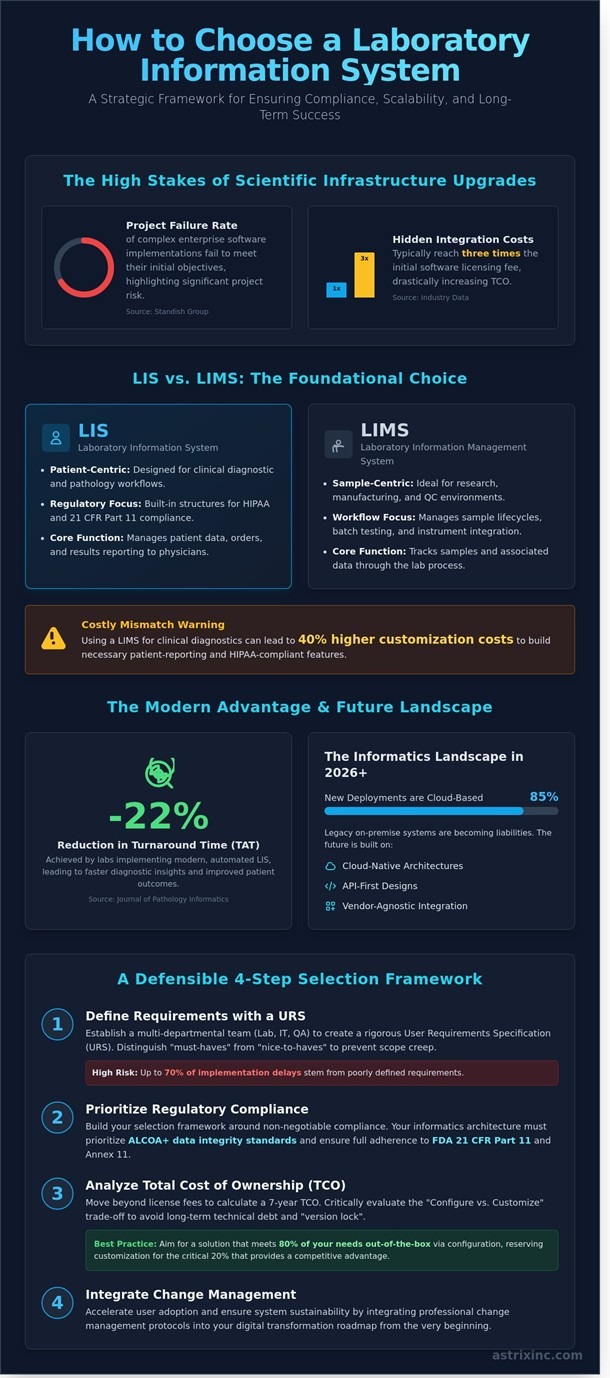
Research from the Standish Group indicates that 66% of complex enterprise software implementations fail to meet their initial objectives, underscoring the significant risk involved in upgrading scientific infrastructure. The real challenge isn’t simply selecting software. It’s avoiding the hidden integration costs that can reach up to three times the initial licensing fee. Choosing a laboratory information system requires moving beyond basic functional checklists to a rigorous, regulatory-first framework that ensures data integrity and traceability across the enterprise.
We provide a defensible selection strategy that supports full compliance with 21 CFR Part 11 while building a scalable informatics architecture. This guide outlines a structured, multi-phase roadmap for Scientific & Laboratory Informatics, progressing from vendor-agnostic requirements gathering to technical validation. You’ll gain the insights needed to transform your lab’s digital landscape into a stable, high-performance environment that supports long-term scientific discovery.
Key Takeaways
- Clarify the strategic distinction between LIS and LIMS to prevent costly procurement decisions that could disrupt clinical, diagnostic, and pathology workflows.
- Master how to choose a laboratory information system by establishing a multi-departmental selection framework centered on a rigorous User Requirements Specification (URS).
- Support compliance with 21 CFR Part 11 and Annex 11 through an informatics architecture that prioritizes ALCOA+ data integrity standards.
- Evaluate the financial implications of “Build vs. Buy” decisions by modeling a 7-year Total Cost of Ownership (TCO) that accounts for long-term scalability and technical debt.
- Accelerate user adoption and long-term system sustainability by embedding formal change management protocols into your digital transformation roadmap.
Defining the Strategic Role of a Modern Laboratory Information System (LIS)
The digital transformation of the modern lab necessitates moving beyond passive data storage to active operational orchestration. In clinical, pathology, and life sciences diagnostics, the Laboratory Information System (LIS) serves as the critical nexus where patient data meets diagnostic precision. It’s no longer sufficient for these platforms to merely record results; they must serve as systems of action that optimize throughput and ensure rigorous compliance with 21 CFR Part 11 regulations for electronic records. Scientific & Laboratory Informatics frameworks now demand that an LIS acts as a central nervous system, coordinating complex workflows across diverse diagnostic disciplines.
Understanding how to choose a laboratory information system begins with recognizing that an LIS is the technical foundation of clinical diagnostic workflows. A 2023 study in the Journal of Pathology Informatics found that laboratories implementing modern, automated LIS solutions achieved a 22% reduction in turnaround time (TAT) for critical results. This efficiency directly correlates with improved patient outcomes, as faster diagnostic insights allow for more immediate therapeutic interventions. By automating the flow of results from instruments to the physician’s portal, a modern system removes the manual bottlenecks that have historically impacted patient safety.
LIS vs. LIMS: Understanding the Functional Boundaries
Selecting the wrong informatics platform can be costly, often resulting from a misunderstanding of functional boundaries. While a LIMS is sample-centric and optimized for research or manufacturing quality control, an LIS is patient-centric and designed for clinical diagnostic environments. Data from industry consultants suggests that laboratories that procure a LIMS for clinical diagnostic purposes incur 40% higher customization costs during implementation. These costs arise from the intensive efforts required to build outpatient reporting modules and HIPAA-compliant data structures that aren’t native to sample-centric systems. In hybrid environments, such as translational medicine facilities, both systems must coexist through robust interoperability frameworks to maintain data integrity across the research-to-clinical continuum.
The Evolving Informatics Landscape in 2026
The 2026 laboratory technology roadmap emphasizes cloud-native architecture and API-first design. Legacy on-premise systems are increasingly liabilities due to their inability to integrate with modern Electronic Health Records (EHR) and high-throughput sequencing instruments. Current market analysis shows that 85% of new laboratory informatics deployments are cloud-based, providing the scalability needed for complex genomic data processing. Strategic selection involves assessing a facility’s Informatics maturity, a metric that evaluates the readiness of existing data governance and infrastructure to support advanced automation. This maturity level determines how to choose a laboratory information system that aligns with long-term digital transformation goals rather than just immediate functional needs.
By prioritizing systems that offer vendor-agnostic integration and real-time analytics, organizations can transition from reactive reporting to proactive lab management. This strategic shift is essential for maintaining a competitive edge in an increasingly data-driven life sciences sector where the science of the lab is inextricably linked to the quality of the informatics infrastructure.
Establishing Your Selection Framework: Business Goals and Technical Requirements
Selecting a LIMS isn’t just a software purchase—it’s a strategic infrastructure decision with high stakes. To understand how to choose a laboratory information system that aligns with scientific objectives, organizations must first achieve internal stakeholder alignment. This includes Lab Directors focused on throughput, IT Managers prioritizing security, and Quality Assurance (QA) officers ensuring compliance with 21 CFR Part 11. Without this cross-functional consensus, projects are prone to scope creep or technical friction during implementation.
A robust User Requirements Specification (URS) serves as the project’s foundation. It’s vital to distinguish between “must-haves” and “nice-to-haves” to avoid over-engineering the solution. Industry data indicates that up to 70% of LIMS implementation delays result from poorly defined requirements at the outset. A weighted scoring matrix allows teams to evaluate vendors based on specific KPIs, such as sample turnaround time or data integrity risk mitigation. Engaging an experienced informatics consultant can help bridge the gap between technical needs and business outcomes.
The “Configure vs. Customize” debate is central to long-term sustainability. Configuration utilizes built-in tools to adapt the software to existing workflows; customization involves writing unique code. While customization might seem attractive for niche processes, it often creates “version lock,” where upgrading the system becomes prohibitively expensive. Aim for a solution that provides 80% of your needs out of the box, reserving customization only for truly proprietary competitive advantages.
Defining Functional vs. Non-Functional Requirements
Functional requirements define what the system does, including workflow automation, result reporting, and accessioning capabilities. These features help ensure daily lab operations remain efficient and compliant. As medical laboratories evolve toward AI-driven data management, greater emphasis must be placed on non-functional requirements.
Non-functional requirements describe how the system performs, encompassing scalability, 99.9% uptime SLAs, and disaster recovery protocols. These factors often drive Total Cost of Ownership (TCO) over a 5- to 7-year lifecycle. If a system cannot scale with your data volume, any initial savings on a lower-cost functional license can be quickly offset by future migration expenses.
The Role of the Request for Proposal (RFP) in Life Sciences
An effective RFP in the life sciences sector requires vendors to demonstrate real-world compliance rather than make vague promises. When determining how to choose a laboratory information system, the RFP process serves as the ultimate filter for vendor viability. Rather than relying on generic sales presentations, request “Day in the Life” scripted demos using your actual lab workflows. This approach reveals whether a platform can manage complex plate maps or multi-step instrument integrations without extensive coding.
- Evaluate vendor financial stability to ensure long-term viability.
- Review their product development roadmap over the next 60 months to ensure alignment with emerging technologies.
- Assess the support structure, focusing on expertise in GxP-regulated environments.
- Verify the vendor’s audit history and approach to validation documentation.
A vendor’s commitment to R&D ensures your informatics ecosystem stays current with shifting FDA data integrity guidelines. By using a structured, weighted matrix, you transform a subjective software demo into an objective, data-driven business decision.
Navigating Regulatory Compliance and Data Integrity Standards
Selecting the right technical architecture requires a rigorous evaluation of the regulatory frameworks that govern the life sciences industry. When determining how to choose a laboratory information system, compliance isn’t a secondary feature; it’s a foundational requirement. Modern laboratories operating under GxP guidelines must ensure their digital infrastructure complies with both 21 CFR Part 11 and Annex 11. These regulations define how electronic records and signatures are managed to ensure they are as trustworthy as paper records. Non-compliance carries significant consequences. Between 2020 and 2022, approximately 79% of FDA warning letters issued to drug manufacturers cited deficiencies in data integrity or record-keeping practices.
Data integrity by design is achieved through the rigorous application of ALCOA+ principles. Every data point generated within the system must be Attributable, Legible, Contemporaneous, Original, and Accurate. The “+” extension adds requirements to include Complete, Consistent, Enduring, and Available. A robust system enforces these through automated workflows, preventing deletion of raw data and capturing every modification in a time-stamped audit trail that identifies the responsible user and reason for the change. Without these safeguards, the risk of human error or intentional data manipulation increases significantly.
The shift from traditional Computer System Validation (CSV) to Computer Software Assurance (CSA) reflects the evolving regulatory expectations. While CSV often relied on burdensome, document-heavy processes, the FDA’s 2022 draft guidance on CSA promotes a risk-based approach that emphasizes critical thinking and functional testing over exhaustive paperwork. Implementing a new system today requires evaluating whether the software supports this streamlined assurance model. It’s often beneficial to engage a vendor-agnostic advisor during this phase. Such experts identify compliance gaps in commercial software that internal teams might overlook, ensuring the platform aligns with the specific “validated state” required for your unique laboratory workflows.
21 CFR Part 11: More Than Just an Audit Trail
This regulation defines the criteria under which the FDA considers electronic records and signatures equivalent to paper records and signatures. It requires closed-loop systems with strictly controlled access and traceable actions. Recent FDA enforcement highlights that simple audit trails are insufficient. Organizations must demonstrate that electronic signatures are uniquely linked to individuals. Systems must also prevent unauthorized access or alteration of clinical data to preserve the chain of custody.
Data Integrity and GxP Readiness
Maintaining a validated state throughout the system’s lifecycle is essential for GxP readiness. This extends beyond the initial setup and requires a vendor with a robust Quality Management System (QMS) that can withstand rigorous audits. Organizations must assess how the software manages unauthorized modification attempts and version control. A system that cannot demonstrate a clear, traceable path of data from acquisition to archiving risks failing regulatory inspections and potentially disrupting production or research activities.
- Audit Trails: Must be human-readable and capture the “who, what, when, and why” of every data change.
- Security Controls: Role-based access control (RBAC) must restrict sensitive functions to qualified personnel only.
- Vendor Quality: The vendor’s development lifecycle (SDLC) must be audited to ensure they follow industry best practices like GAMP 5.
- Data Archival: Records must remain accessible and legible for the duration of the required retention period, often spanning decades.
Understanding how to choose a laboratory information system involves recognizing that the software is a tool for scientific discovery that must also serve as a legal record. By prioritizing these compliance standards during the selection process, organizations protect their intellectual property and their regulatory standing. The goal is to create a digital environment where data integrity is an inherent outcome of the laboratory’s daily operations.
The Build vs. Buy vs. Partner Analysis
Determining how to choose a laboratory information system requires a rigorous evaluation of long-term sustainability rather than immediate functionality alone. Organizations often face a critical fork in the road: develop a proprietary solution internally or purchase a Commercial Off-the-Shelf (COTS) platform. While custom builds offer a high degree of initial personalization, they frequently fail to account for the comprehensive Total Cost of Ownership (TCO) over a standard seven-year horizon. A lifecycle analysis reveals that COTS solutions, despite their upfront licensing fees, typically result in 30% lower total costs compared to internal builds. This discrepancy arises from the hidden burdens of security patches, hardware refreshes, and the intensive scientific staffing required to keep custom systems compliant with evolving 21 CFR Part 11 regulations.
Successful implementation depends on bridging the gap between raw software capabilities and the practical realities of the lab bench. This is where strategic consulting becomes essential. Scientific informatics experts do more than install software; they align technology with specific GxP workflows to ensure data integrity. Without this strategic layer, even the most sophisticated COTS platform risks becoming little more than a digital filing cabinet. Organizations must engage scientific staff throughout the selection and maintenance phases to ensure the system supports actual discovery processes rather than introducing new administrative bottlenecks.
Hidden Costs of the “Build” Approach
Custom code creates immediate technical debt that compounds over time. Internal IT teams rarely possess the deep domain expertise necessary to maintain rigorous GxP compliance as global regulatory landscapes shift. A significant operational risk is “key person dependency,” where the entire system’s viability hinges on a single developer or a small group of internal architects. Industry data suggests that 70% of homegrown laboratory systems are decommissioned or replaced within five years. These systems often fail because they cannot scale with new instrument integrations or adapt to the high throughput demands of modern life sciences. Custom systems lack the interoperability of modern platforms, which eventually forces a costly migration to a COTS solution to maintain a competitive edge.
The Value of Vendor-Agnostic Consulting
Selecting the wrong platform can cost millions and stall drug development for years. Vendor-agnostic consultants provide an objective layer of scrutiny that internal teams or software sales representatives cannot replicate. They conduct a detailed gap analysis to ensure the chosen system meets at least 90% of functional requirements without extensive customization. This objective approach helps laboratories avoid the “feature trap” where unnecessary modules add complexity without value. By engaging Astrix Laboratory Informatics Consulting Services, organizations secure a strategic partner capable of navigating the intricate digital and regulatory landscape of the life sciences sector.
Ready to align your informatics strategy with your scientific goals? Contact Astrix today for expert LIMS selection guidance.
Implementation Strategy and Sustaining Your Informatics Ecosystem
Selecting the ideal platform is only the foundation of a successful digital transformation. The deployment methodology determines whether the laboratory achieves its projected return on investment. While organizations often focus solely on technical specifications, the ‘how’ of implementation is just as important as the ‘what’ of software. Understanding how to choose a laboratory information system requires looking beyond the feature list to evaluate the deployment approach and the vendor’s capacity to support long-term operational goals.
A McKinsey study indicates that 70% of complex digital transformations fail, largely due to inadequate change management and cultural resistance. To avoid this, leadership must prioritize user adoption strategies that address the human element of laboratory workflows. This involves identifying “Super Users” within the laboratory who can champion the system and provide peer-to-peer training. Staffing requirements don’t end at go-live. You’ll need a dedicated team for system administration, including database managers and scientific business analysts who bridge the gap between IT and the bench.
Success metrics must be defined early and tracked rigorously over the first 12 months. Key performance indicators (KPIs) include:
- A 30% reduction in manual data transcription errors within the first six months.
- Full compliance with 21 CFR Part 11 audit trail requirements during the first internal audit.
- A 15% improvement in sample turnaround times (TAT) across the core laboratory functions.
- User proficiency scores exceeding 85% following the initial onboarding period.
The Phased Implementation Roadmap
Attempting a “Big Bang” rollout in a complex life sciences environment introduces unacceptable risk to data integrity and operational continuity. An iterative approach allows for pilot programs in specific departments, such as Quality Control or R&D before a global scale-up. This strategy mitigates risk by isolating technical hurdles early. A dedicated Validation Engineer is essential during this phase. They ensure the system strictly adheres to the User Requirement Specifications (URS) and GxP standards, providing the documented evidence required for regulatory audits. This professional oversees the Installation Qualification (IQ), Operational Qualification (OQ), and Performance Qualification (PQ) processes, ensuring the system is fit for its intended use in a regulated environment.
Building a Long-Term Support Model
The informatics journey continues long after the initial go-live date. Organizations must decide between internal staff augmentation and managed services for ongoing system administration. Maintaining continuous compliance is a primary challenge, especially as software updates occur in a validated environment. Under FDA guidelines, each patch or upgrade requires a risk-based assessment to determine the extent of re-validation necessary. This prevents “validation debt” from accumulating and ensures the system remains in a controlled state. When evaluating how to choose a laboratory information system, consider the long-term roadmap for interoperability with other tools such as ELNs or SDMS. Partner with Astrix for your end-to-end informatics journey to ensure your system remains optimized, compliant, and scalable as your scientific goals evolve.
Accelerating Discovery Through Strategic Informatics Selection
Selecting an informatics platform is a high-stakes decision that shapes your organization’s scientific velocity for the next decade. Success requires a rigorous alignment between business objectives and technical specifications, ensuring strict adherence to 21 CFR Part 11 and GAMP 5 standards. When evaluating how to choose a laboratory information system, you decide how to balance immediate functional needs with long-term scalability and regulatory compliance. Astrix brings over 25 years of scientific informatics expertise to navigate these complexities. We’ve supported global life sciences firms in achieving digital transformation through a vendor-agnostic approach that prioritizes your specific ROI. Our team applies deep regulatory knowledge to ensure your ecosystem remains compliant under evolving global mandates. By moving beyond a simple software purchase toward a structured informatics roadmap, you’ll transform your laboratory from a cost center into a strategic engine of discovery. It’s time to build a foundation that supports both current throughput and future innovation.
Frequently Asked Questions
What is the average cost of implementing a new LIS in a life sciences lab?
Implementation costs for a new system typically range from $150,000 to over $1 million for enterprise-scale life science organizations. Gartner research indicates that professional services and configuration costs often amount to 150% to 200% of the initial software licensing fee. These costs typically cover data migration, system integration, and the rigorous validation protocols required by regulatory authorities.
How long does the LIS selection and implementation process typically take?
The complete lifecycle from selection through deployment generally spans 9 to 15 months. Strategic selection phases typically require 3 to 4 months of stakeholder interviews and vendor demonstrations. Implementation, including workflow configuration and technical validation, adds 6 to 11 months, depending on the complexity of the laboratory’s existing digital infrastructure.
What are the most common mistakes laboratories make when choosing an LIS?
The most frequent error is failing to define comprehensive user requirements before evaluating vendors. McKinsey research indicates that 70% of digital transformations fail to meet initial objectives due to misaligned technical specifications. When determining how to choose a laboratory information system, laboratories often prioritize software features over long-term interoperability and data integrity.
Does an LIS need to be FDA 21 CFR Part 11 compliant for research-only laboratories?
Research-only laboratories are not strictly required to comply with 21 CFR Part 11 if their data does not support a regulatory submission. However, the FDA expects compliance for any electronic records submitted under the Federal Food, Drug, and Cosmetic Act. 85% of research institutions implement these controls early to ensure data remains viable for future patent filings or clinical transitions.
How do I determine if my lab needs a LIMS or an LIS?
You’ll need an LIS if your primary focus is patient-centric clinical diagnostics and CLIA compliance. A LIMS is necessary for sample-centric R&D, manufacturing, or QC environments where ISO 17025 or GxP standards apply. Understanding this distinction is vital for anyone researching how to choose a laboratory information system that aligns with their specific operational mandate.
What is the role of an informatics consultant in the LIS selection process?
An informatics consultant provides vendor-agnostic technical expertise and strategic project management. These experts mitigate risk by conducting formal gap analyses and managing the 12 to 15 key milestones of the implementation roadmap. Industry data shows that consultant-led projects are 40% more likely to stay within their original budget and timeline constraints.
Can a cloud-based LIS meet strict GxP and data integrity requirements?
Cloud-based systems can absolutely meet GxP requirements through rigorous SOC 2 Type II audits and adherence to Annex 11. By 2023, over 75% of new informatics deployments in life sciences had shifted to SaaS models. These platforms use automated validation tools to maintain continuous compliance during software updates.
How often should a laboratory re-evaluate its informatics strategy?
Organizations should reassess their informatics strategy every 36 to 60 months. Rapid increases in data volume and the rise of AI-driven analytics mean systems older than five years often become bottlenecks. Approximately 62% of market leaders conduct biennial audits to ensure their digital roadmap aligns with current
About Astrix
Astrix is the global leader in delivering innovative strategies, solutions, and talent to the life sciences industry. Powered by world-class people, proven processes, and advanced technology, Astrix partners with clients to drive measurable improvements in business performance, scientific advancement, and clinical outcomes—ultimately driving towards a goal of improving quality of life. Founded by scientists to address the industry’s most complex challenges, Astrix provides a growing portfolio of strategic and technical services that deliver immediate impact while enabling long-term digital transformation. Our deep expertise spans strategic planning, data strategy, AI/ML readiness and technologies, lab informatics, and modern clinical operations and eClinical platforms so we can successfully deliver solutions that have high impact and drive better outcomes for everyone.
Case Study: LabWare Centralized Data Review for a Global Biopharmaceutical Company
Overview A global biopharmaceutical company specializing in discovery, development,... LEARN MOREWhite Paper: Managing Data Integrity in FDA-Regulated labs.
New White Paper LEARN MORELET´S GET STARTED
Contact us today and let’s begin working on a solution for your most complex strategy, technology and strategic talent services.
CONTACT US