

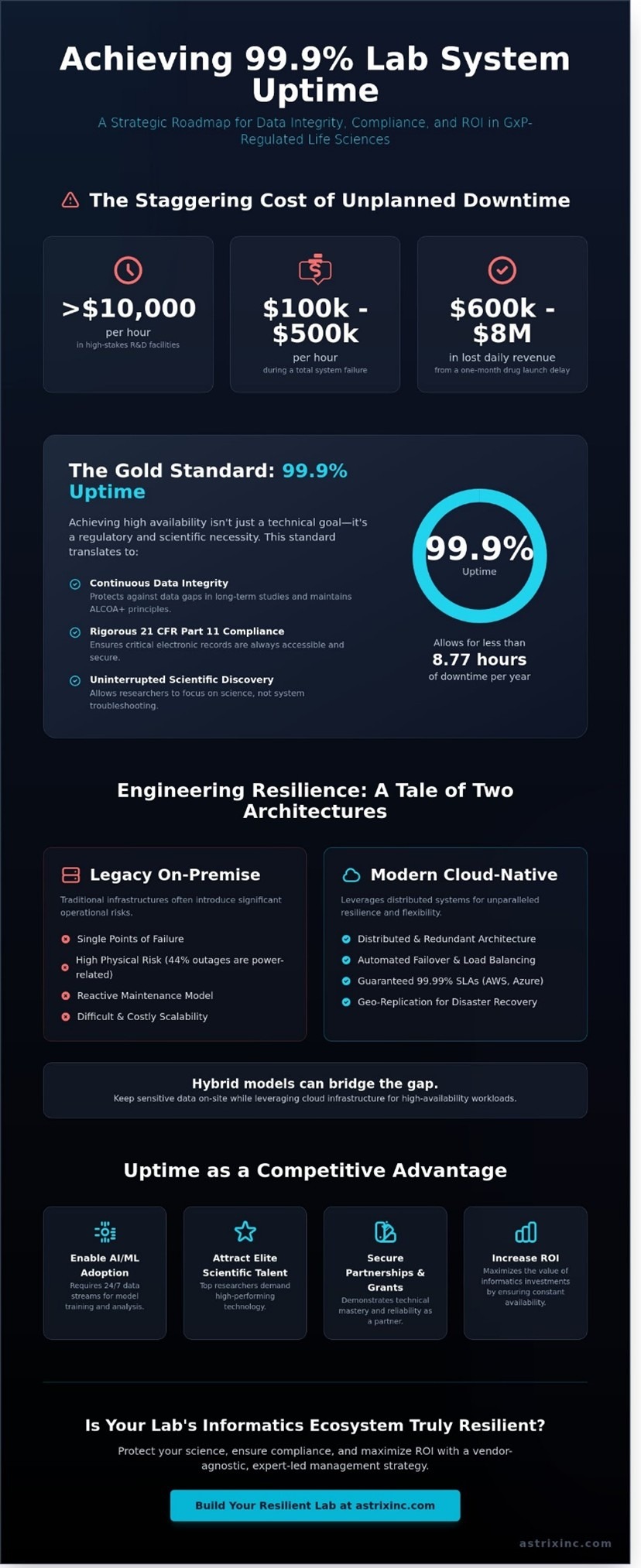
Unplanned downtime in a life sciences environment is more than an IT disruption. It creates direct operational and scientific risk. Industry analyses of high-throughput R&D and QC environments estimate that each hour of system unavailability can cost more than $10,000 in lost productivity, not including downstream impacts on batch release, study timelines, and regulatory deliverables. In an ecosystem where LIMS, ELN, CDS, and instrument integration layers support core laboratory operations, maintaining uptime is a fundamental requirement for reliable scientific and business performance.
Modern laboratory informatics architectures are increasingly distributed and API driven. They depend on specialized skill sets that remain in short supply. A single failure in workflow orchestration, data pipelines, or system integrations can compromise data integrity, disrupt regulated processes, and put compliance with 21 CFR Part 11 and internal quality standards at risk.
This guide provides technical, regulatory, and operational strategies to achieve and sustain 99.9% or higher informatics availability in complex, highly regulated environments. It outlines a vendor‑agnostic roadmap that strengthens business continuity, lowers integration risk, and stabilizes the digital ecosystem. With the right governance model and expert‑led oversight, organizations can mitigate operational risk and improve the performance of their LIMS, ELN, and supporting informatics systems.
Key Takeaways
- Quantify the economic and regulatory impact of informatics downtime in GxP environments to support a strong business case for high availability.
- Apply technical strategies that improve uptime through redundant cloud native architectures and automated failover protocols.
- Maintain rigorous compliance with 21 CFR Part 11 and ALCOA+ principles through validated systems, controlled records, and strong procedural governance.
- Ensure continuous access to critical electronic records to preserve data integrity and support uninterrupted operations.
- Establish a proactive operational framework that combines preventive maintenance schedules with expert LIMS administration to preempt system failures.
- Utilize a vendor-agnostic approach to select resilient informatics platforms that support long-term digital transformation and scientific discovery.
The Strategic Importance of Lab System Uptime in Life Sciences
Laboratory uptime is a key metric for operational continuity within GxP-regulated environments. It reflects the percentage of time that Scientific and Laboratory Informatics platforms, such as LIMS, ELN, and CDS, remain fully functional and accessible to researchers. For organizations governed by 21 CFR Part 11, availability supports compliance expectations. Achieving high availability, including the 99.9% benchmark, limits unplanned downtime to less than 8.77 hours per year. This level of performance is essential because interruptions can disrupt the chain of custody and compromise research if real-time data capture is lost.
Unplanned outages carry measurable operational and financial consequences. Industry analyses indicate that mid- to large-scale life science organizations may lose between $100,000 to $500,000 per hour during total system failures. These estimates account for the loss of reagents, stalled analytical workflows, and scientific staff who cannot record observations or retrieve protocols. Secondary effects include delays in regulatory submissions and extended development timelines. A one-month delay in product launch can reduce potential daily revenue by hundreds of thousands to several million dollars, depending on the therapeutic area. Ensuring lab system uptime requires a shift from reactive troubleshooting to an engineered resilience approach and strict regulatory compliance.
Calculating the Financial Impact of Unplanned Downtime
Direct costs arise from the loss of high-value reagents and degradation of temperature or time-sensitive biological samples that rely on continuous monitoring through integrated informatics systems. Indirect costs include reduced stakeholder confidence and the administrative burden of deviation records and nonconformance reports required for regulatory review. Opportunity costs in drug discovery and development arise when scientific personnel are diverted from advancing toward patent filings or clinical milestones to resolve technical failures rather than advancing the research pipeline.
Uptime as a Competitive Advantage
Resilient systems serve as the backbone for an organization’s digital transformation roadmap, enabling the seamless adoption of AI and machine learning tools that require 24/7 data streams. Organizations that prioritize system reliability attract skilled scientific talent who demand high-performing technology to execute complex workflows without interruption. By maintaining consistent data availability, labs strengthen their reputation, which is essential for securing partnerships and federal grants.
- 99.9% uptime prevents data loss in long-term stability studies by ensuring uninterrupted acquisition of environmental and analytical measurements.
- Redundant informatics architectures safeguard research data and intellectual property during hardware or infrastructure component failures.
- High system availability shortens the mean time to recovery (MTTR) for clinical and preclinical datasets by enabling faster restoration of validated records and workflows.
Engineering Resilience: Technical Architectures for High Availability
Building a resilient foundation for Scientific and Laboratory Informatics requires moving from reactive maintenance to deliberate architectural design. Legacy on-premise servers often introduce single points of failure that can disrupt high-throughput laboratory workflows supported by LIMS and CDS platforms for extended periods. Transitioning to cloud-native informatics allows labs to leverage a distributed architecture. These systems use load balancing to distribute traffic across multiple nodes, ensuring that if one instance fails, user sessions remain uninterrupted. Geo-replication provides an additional layer of safety by mirroring data across different geographic regions, protecting against localized disasters. Effective strategies for ensuring lab system uptime rely on these redundancies to minimize downtime during both planned updates and unexpected failures.
Cloud vs. On-Premise: Reliability Benchmarks
Reliability benchmarks consistently favor cloud environments for most life sciences workloads. Major providers such as AWS and Microsoft Azure publish Service Level Agreements (SLAs) with availability targets near 99.99% for core infrastructure services. Local hardware, by contrast, is exposed to physical risks that are difficult to mitigate at a reasonable cost. The Uptime Institute’s 2022 Global Data Center Survey reports that power-related issues account for a significant share of outages. Typical on‑premise server rooms lack the redundant power distribution, environmental controls, and advanced fire suppression systems found in Tier IV data centers. Hybrid deployment models can address these limitations by allowing organizations to retain sensitive data on-site while using cloud infrastructure to support high-availability workloads. This approach aligns with 21 CFR Part 11 expectations for data security, integrity, and continuous accessibility.
Implementing Robust Disaster Recovery (DR) Plans
Disaster recovery is a critical component of a strategic roadmap for digital transformation. Organizations must define clear Recovery Time Objectives (RTO) and Recovery Point Objectives (RPO). For a GxP-regulated laboratory, an RPO of zero might be required to prevent data loss that could invalidate an entire batch. Regular disaster recovery exercises are essential. A 2023 industry analysis found that 23% of organizations do not test their recovery plans each year, which increases the likelihood of failure during an actual incident.
Automated backup verification ensures that stored data remains uncorrupted and ready for restoration. Every DR site must maintain the same validation status as the production environment to meet FDA data-integrity requirements. Integrated monitoring tools use predictive analytics to identify hardware degradation before it causes a system crash, providing a proactive approach to ensuring lab system uptime across integrated LIMS, ELN, and CDS platforms.
Regulatory Imperatives: Ensuring Uptime for Data Integrity
Within the ALCOA+ principles, availability is a critical pillar that dictates how data remains accessible to authorized personnel during inspections or routine operations. When evaluating how to ensure lab system uptime, organizations must recognize that periods of unavailability can create compliance risk under 21 CFR Part 11. This regulation mandates that electronic records remain protected and readily retrievable throughout their designated retention period. System outages do more than pause productivity. They introduce potential gaps in metadata and audit trails that are difficult to reconstruct with validated accuracy. In 2022, the FDA issued multiple Form 483 observations citing missing or incomplete metadata during system outages as a primary finding, underscoring the regulatory impact of technical failures in a GxP environment.
Maintaining Data Integrity During System Outages
During unplanned outages, laboratories often revert to manual paper processes to maintain continuity. This transition introduces a risk of data orphaning, where the physical record cannot be reliably reconciled with the digital audit trail once the system is restored. The FDA’s 2018 Data Integrity and Compliance with CGMP guidance clarifies that electronic record retention must include all original records and metadata. If a system failure results in lost data, the regulatory consequences can range from mandatory re-testing to the invalidation of entire batches. Statistics from industry audits suggest that 15% of data integrity failures stem from improper handling of data during system transitions or crashes. Effective recovery procedures must prioritize the following actions:
- Immediate capture of manual data into the digital system upon restoration to maintain contemporaneity.
- Verification of audit trail continuity to ensure no unauthorized changes occurred during the downtime.
- Documentation of the outage period within the system’s deviation log to provide a transparent record for auditors.
Risk-Based Updates for Validated Systems
Managing system patches and updates requires a careful balance between security and preserving a validated state. A risk‑based approach, as outlined in GAMP 5, enables targeted testing of updates without triggering a full revalidation of the entire Scientific & Laboratory Informatics ecosystem, thereby protecting both interoperability and compliance.
This strategy is essential for sustaining lab system uptime because it eliminates the version lock that often constrains legacy platforms. By incorporating automated testing tools, organizations can reduce validation cycle time by up to 40%, ensuring that critical security patches do not result in prolonged system unavailability. Maintaining a validated state remains the central driver of long‑term system reliability and procedural consistency.
The Human Factor: Proactive Maintenance and Specialized Staffing
The human element remains the most critical driver of lab system uptime in regulated laboratory environments. While hardware and software provide the foundational infrastructure, the expertise of informatics professionals determines system longevity. A LIMS Administrator monitors performance and helps prevent failures by overseeing key maintenance tasks that reduce the majority of system disruptions. According to a 2023 Ponemon Institute report, the average cost of a single minute of data center downtime has risen to approximately $9,000, reinforcing the financial impact of laboratory informatics stability.
Effective maintenance requires a rigorous Preventive Maintenance (PM) schedule that aligns with 21 CFR Part 11 requirements for system validation and audit-trail integrity. Continuous training serves as a vital buffer against user-driven instability. When laboratory staff understand the technical nuances of a LIMS or ELN, they’re less likely to introduce errors or improper data entry that can cause system crashes. This commitment to operational rigor ensures that technology supports scientific work rather than interrupting it.
Establishing a Proactive Maintenance Workflow
A structured workflow identifies technical risks before they manifest as systemic downtime. Teams should monitor leading indicators such as database latency, system load, and storage behavior. For example, if database response times increase by 15% over a seven-day period, it often signals impending index failure or storage saturation. A vendor-agnostic approach to technical support ensures that troubleshooting remains objective, prioritizing the laboratory’s specific ecosystem over a single software provider’s agenda. This methodology facilitates the interoperability required in modern, heterogeneous digital landscapes.
Implementing a Holistic Uptime Strategy with Astrix
A strong uptime strategy connects laboratory operations with business objectives. It requires more than reactive fixes. It depends on resilient platforms that align with scientific needs. Experienced consultants help modernize legacy systems and guide transitions to scalable architectures that meet both regulatory and performance requirements. A vendor‑neutral approach ensures that technology supports scientific workflows rather than constraining them. This alignment improves flexibility and long‑term reliability.
Astrix provides vendor‑agnostic guidance to help organizations modernize legacy systems and adopt scalable, compliant architectures. With more than twenty‑five years of life‑science experience, we align your informatics ecosystem with scientific and business objectives so that technology supports your workflows rather than limiting them.
The Astrix Strategic Roadmap for Lab Resilience
Our methodology for maintaining operational continuity follows a structured, three-phase progression designed to eliminate single points of failure:
- Phase 1: We conduct a comprehensive current state assessment. This involves identifying hidden risks in your existing informatics stack, such as outdated middleware, non-compliant data silos, or hardware nearing end-of-life.
- Phase 2: Our architects design a high-availability environment tailored to your science. We focus on creating a redundant infrastructure that keeps LIMS and ELN platforms interoperable and stable under heavy workloads.
- Phase 3: This stage covers rigorous implementation and validation. We provide ongoing managed support to maintain operational rigor and ensure your systems evolve as your laboratory grows.
Achieving ROI Through System Stability
Unplanned downtime is a significant financial burden. Research from the ITIC 2022 Global Server Hardware and OS Reliability Report indicates that a single hour of downtime costs over $300,000. In life sciences, these costs are compounded by the risk of losing irreplaceable experimental data or jeopardizing GxP audit outcomes. Astrix clients have achieved measurable improvements through our proactive management strategies, with some reporting a 45% reduction in system outages within the first year of partnership.
These stability gains translate into long-term cost savings by reducing the need for emergency IT interventions and accelerating time-to-market for critical therapies. System reliability is a requirement for modern scientific discovery. By integrating technical mastery with industry-specific regulatory knowledge, we help you build a foundation that supports continuous innovation. Contact Astrix for a Laboratory Informatics Strategy Consultation to begin optimizing your infrastructure today.
Securing the Future of Scientific Discovery through Operational Excellence
Ensuring lab system uptime requires a shift from reactive troubleshooting to an engineered resilience framework and strict regulatory compliance. Organizations must align their technical architectures with 21 CFR Part 11 requirements to protect data integrity and maintain a continuous audit trail. Research from ITIC indicates that 91% of enterprises lose over $300,000 for every hour of unplanned downtime, making proactive maintenance a necessary financial practice rather than an optional one. Success depends on integrating sophisticated LIMS and ELN platforms with a strategy that prioritizes high availability and expert oversight.
Astrix provides the expertise needed to navigate these complex digital environments. With over 25 years of specialized life science experience and a global footprint spanning the US, Europe, and Costa Rica, our consultants offer deep expertise across all major LIMS and ELN platforms. We’ll help you move beyond simple software implementation toward a state of total operational reliability. Partner with Astrix for Expert Lab Informatics Services to secure your laboratory’s digital future and accelerate your scientific breakthroughs.
Frequently Asked Questions
What is the difference between high availability and disaster recovery in a lab setting?
High availability focuses on minimizing downtime through redundant hardware and software components, while disaster recovery focuses on restoring systems after a catastrophic failure. High availability aims for 99.999% uptime by eliminating single points of failure. In contrast, disaster recovery protocols define the Recovery Time Objective and Recovery Point Objective to ensure data integrity following a major disruption.
How does 21 CFR Part 11 impact my lab system uptime strategy?
21 CFR Part 11 mandates that electronic records remain accessible and accurate, requiring a robust strategy to maintain lab system uptime and prevent data loss. Since the FDA requires audit trails to be generated at the time of data entry, any system outage risks non-compliance by preventing the capture of critical metadata. Labs must maintain high availability to ensure that the electronic signatures and records required by these 1997 regulations aren’t compromised by unplanned downtime.
What are the most common causes of LIMS downtime in pharmaceutical labs?
Hardware failures and software configuration errors account for approximately 40% of unplanned downtime in pharmaceutical laboratories. A 2023 industry survey indicated that 25% of outages stem from human error during manual data entry or system updates. Integration challenges between the LIMS and legacy laboratory instruments also contribute to 15% of system instabilities. This highlights the need for rigorous interoperability testing during the digital transformation process.
Can cloud-based LIMS really offer better uptime than on-premise systems?
Cloud-based LIMS typically deliver higher uptime, often exceeding 99.9%, compared to the 95 to 98% range seen in self-managed on-premise environments. It is a proven model in which service-level agreements from major providers ensure high availability through geographically distributed data centers. This infrastructure reduces the risk of local power failures or hardware obsolescence, which industry estimates can cost up to $5,600 per minute of downtime.
How often should I perform system validation to ensure stability?
System validation should occur during initial implementation, after any significant software update, or at a minimum every 12 to 18 months to maintain regulatory compliance. The FDA’s General Principles of Software Validation guidance outlines a risk-based approach to determining validation scope based on software complexity and risk. Regular re-validation prevents performance degradation, ensuring the scientific informatics ecosystem remains reliable and audit-ready as laboratory requirements evolve. It’s a critical step in maintaining a steady, compliant environment.
What is the role of a LIMS administrator in preventing unplanned outages?
A LIMS administrator prevents outages by performing proactive monitoring, managing user permissions, and executing scheduled maintenance protocols. By identifying performance bottlenecks before they cause a crash, the administrator maintains the strategic roadmap for system health. Their role includes overseeing key maintenance tasks that prevent the majority of critical failures. This keeps technology aligned with the needs of scientific discovery and routine laboratory operations.
How can I calculate the ROI of investing in a high-availability infrastructure?
Calculating ROI involves comparing the cost of high-availability infrastructure with the potential financial loss from downtime, which averages $300,000 per hour for large enterprises, according to 2022 industry data. To determine the return, divide the annual cost of avoided outages by the total investment in redundant hardware and failover software. This quantitative analysis demonstrates how a stable informatics environment protects the organization’s research investments and accelerates time-to-market for new therapies.
Does staff augmentation help improve system uptime?
Staff augmentation improves system uptime by providing specialized technical expertise that internal teams may lack, particularly during complex migrations or upgrades. External consultants bring vendor-agnostic insights that help identify 30% more potential failure points during the planning phase. This approach enables internal teams to focus on research while experts maintain system reliability and uptime.