

The life sciences industry is at a critical inflection point in 2026, as the limitations of siloed, on-premise laboratory systems have become measurable risks to quality, compliance, and scalability. Scientists in traditional laboratories spend an estimated 30% to 40% of their time on administrative data management rather than active research, while manual data entry error rates of 1% to 6% continue to hinder operational efficiency and delay real-time batch release. With the FDA’s Quality Management System Regulation (QMSR) in a regulatory transition period, organizations are accelerating their shift toward unified, cloud-native architectures that strengthen ALCOA+ data integrity, streamline laboratory operations, and support long-term regulatory readiness.
As organizations modernize their laboratory and quality ecosystems, Veeva LIMS has emerged as a modern, platform-centric solution built on the broader Veeva Vault ecosystem to unify QC workflows, reduce fragmentation, and modernize scientific data management. This article provides a practical framework for executives evaluating Veeva LIMS, including guidance for aligning platform capabilities with laboratory requirements, building a strategic business case for leadership, and understanding how modern informatics investments can transform laboratory data from a compliance obligation into a long-term strategic asset.
Key Takeaways
- Understand why modern LIMS represents a platform-centric approach to scientific data management, enabling a strategic shift from siloed legacy systems to unified cloud architectures.
- Identify the core functional requirements for sample management, stability testing, and environmental monitoring to ensure technical alignment with your organization’s specific laboratory workflows.
- Quantify the financial impact of digital transformation by analyzing the total cost of ownership and how automated batch release reduces inventory holding costs.
- Discover a structured roadmap for selecting and making a business case for Veeva LIMS, leveraging Computer Software Assurance (CSA) principles to streamline validation and strengthen regulatory compliance.
The Strategic Imperative for Modernizing Laboratory Informatics
Increasing regulatory pressure and the need for real-time operational visibility are exposing the limitations of siloed, on-premise systems as measurable business and compliance risks rather than isolated operational inefficiencies. Organizations are accelerating their move toward unified, cloud‑native architectures to eliminate the bottlenecks inherent in fragmented data environments. A modern Laboratory Information Management System (LIMS) provides a platform‑centric model for scientific data management, unifying quality control and research workflows into a single source of truth. Without this integration, data fragmentation continues to lengthen R&D cycle times and erode QC efficiency, contributing to the escalating costs associated with bringing new therapies to market.
Drivers of Digital Transformation in Life Sciences
The rise of complex biotherapeutic modalities such as cell and gene therapies demands a level of granular, traceable data management that legacy laboratory systems struggle to support. Achieving the “Lab of the Future” requires a centralized informatics foundation that ensures data is findable, accessible, interoperable, and reusable (FAIR), while maintaining rigorous compliance and audit readiness. FDA inspection trends in recent years continue to highlight recurring quality system and data integrity issues, underscoring the financial and reputational risks associated with inadequate laboratory controls. Against this backdrop, selecting and making a strategic business case for Veeva LIMS enables organizations to replace manual, error-prone processes—often associated with error rates of 1% to 6%—with automated, compliant workflows that strengthen data integrity and operational efficiency.
Regulatory Pressures and Compliance Risks
Maintaining the status quo creates technical debt that can compromise product quality, patient safety, and regulatory authorization. Regulations such as 21 CFR Part 11 and EU Annex 11 have evolved to place greater emphasis on validated electronic systems, data integrity, and adherence to ALCOA+ principles. The Quality Management System Regulation (QMSR), which aligns with ISO 13485:2016 and is currently in a regulatory transition period, further underscores the need for robust laboratory controls and integrated quality oversight throughout the product lifecycle. For many life sciences leaders, building a strategic business case for Veeva LIMS represents a practical path to mitigating the risk of regulatory findings, including warning letters, while ensuring that every data point remains attributable, legible, contemporaneous, original, and accurate. Outdated systems don’t just slow release timelines; they undermine the integrity of the scientific record.
Evaluating Veeva LIMS: Selection Criteria and Technical Alignment
Evaluating a platform of this magnitude requires a methodology that balances immediate functional needs with long-term enterprise objectives. When selecting and making a business case for Veeva LIMS, decision-makers must look beyond feature lists and assess how the system aligns with their digital maturity roadmap. Laboratories that have adopted automated informatics report up to increased sample throughput and laboratory capacity—gains achievable only when the underlying architecture supports seamless data flow across the laboratory ecosystem. Engaging expert laboratory informatics services early in the vendor selection process can help clarify these requirements and ensure the evaluation is grounded in both operational and strategic priorities.
Functional vs. Strategic Selection Criteria
Functional requirements must address the specificities of your assays and workflows, including robust sample management, stability testing, and environmental monitoring. However, strategic selection criteria are equally important. Organizations should assess whether the platform aligns with an enterprise cloud-first strategy and provides the API capabilities required for validated laboratory instrument integration via connectivity frameworks. The unified platform advantage is a key differentiator, as Veeva LIMS integrates natively with Vault QualityDocs and QMS, ensuring that quality data is not trapped in silos but is available for real-time decision-making.
The Cloud-Native Advantage for Life Sciences
Cloud-native laboratory platforms such as Veeva LIMS offer a fundamentally different operating model from legacy on-premise systems, shifting organizations away from costly upgrade cycles toward continuous innovation and simplified lifecycle management. Built on the Veeva Vault platform, this approach improves scalability, enabling laboratories to expand from individual sites to global networks without the infrastructure constraints of traditional architectures, while also supporting more consistent security and validation frameworks across the enterprise.
Usability and data integrity are critical drivers of adoption, particularly in regulated laboratory environments. Veeva LIMS intuitive system design directly supports adoption and helps reduce the impact of manual data entry errors, which can range from 1% to 6%, strengthening ALCOA+ compliance and reducing downstream quality risk. More broadly, Veeva’s platform strategy is increasingly evaluated for its ability to support long-term data use cases, including structured data capture aligned with FAIR principles and future applications such as advanced analytics and machine learning.
Constructing a Quantitative Business Case and ROI Framework
Building a robust justification for digital transformation requires moving from qualitative benefits to a rigorous, data-driven financial model. In building a business case for Veeva LIMS, executives must evaluate the total cost of ownership (TCO) beyond direct licensing to include the high non-recurring costs of GxP validation, which can range from $15,000 to $75,000 per environment. Unlike legacy on-premise systems that require substantial capital expenditure for infrastructure maintenance and periodic hardware refreshes, cloud-native models shift these costs into predictable operating expenses. In addition, automated batch release can reduce inventory holding costs by accelerating the movement of finished goods from the laboratory to the distribution chain.
Operational Efficiency and Labor Reduction
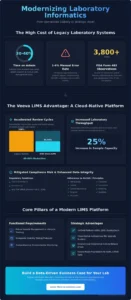
Labor represents one of the highest costs in the modern laboratory, with scientists often spending up to 40% of their time on administrative data management. Implementing a unified informatics platform can reduce data review cycles by 40% to 60%, enabling scientific staff to dedicate more time to research, experimental design, and other value-generating activities. This efficiency improves overall throughput and contributes to a more sustainable and engaging work environment by reducing reliance on repetitive, error-prone tasks. Organizations that leverage strategic consulting services often find that these labor savings alone can justify the initial investment within the first 24 to 36 months of operation.
Risk Mitigation and Compliance Value
A modern LIMS helps organizations reduce the costs associated with regulatory non-compliance. FDA inspection trends, including thousands of Form 483 observations issued annually, underscore the persistent risk of data integrity and quality system failures. In life sciences, such failures can have significant consequences, including delays in market authorization for therapies that may require over $2 billion in development investment. Faster, more reliable release cycles directly improve the net present value (NPV) of drug candidates by shortening time-to-market and reducing uncertainty in commercialization timelines. A well-constructed sensitivity analysis should account for these variables and demonstrate how a strategic investment in Veeva LIMS can help protect long-term enterprise value by reducing the likelihood of audit findings, warning letters, and product recalls.
Navigating the Implementation Roadmap and Compliance Integration
Successful deployment requires more than technical configuration. It demands rigorous alignment of laboratory processes with the platform’s native capabilities. While making a business case for Veeva LIMS establishes strategic intent, the implementation phase determines realized ROI through risk-based validation and disciplined data migration. A platform-neutral advisory model helps prevent the migration of legacy inefficiencies into the new environment. This model emphasizes the full data lifecycle, ensuring that records remain compliant with 21 CFR Part 11 and the Quality Management System Regulation (QMSR), which reinforces modern expectations for integrated quality oversight and data integrity.
The evolution from traditional Computer System Validation (CSV) to Computer Software Assurance (CSA) reflects a broader shift toward risk-based validation strategies that prioritize critical thinking over documentation volume. By focusing validation efforts on system risk and intended use, laboratories can reduce validation timelines without compromising data integrity. This is especially important during historical data migration, where preserving the ALCOA+ principles of original and accurate data is essential for audit readiness. Similarly, emerging regulatory expectations for laboratory-developed tests (LDTs) further reinforce the need for LIMS platforms that support rigorous traceability, registration, and labeling compliance.
This structured approach is typically operationalized through a phased implementation methodology that aligns process design, system configuration, and validation activities to ensure controlled, adoption-focused deployment.
The Phased Implementation Methodology
- Phase 1: Process mapping and gap analysis against “Out-of-the-Box” functionality to minimize custom coding.
- Phase 2: Configuration and integration with existing lab ecosystems, including instrument connectivity via the Laboratory Device Integration Framework.
- Phase 3: Validation, comprehensive user training, and Go-Live support to ensure high adoption rates.
Maintaining a Validated State in the Cloud
Maintaining a validated state in a cloud environment requires a proactive approach to managing continuous release cycles, including regular platform updates delivered through Veeva’s scheduled release model. Organizations can leverage pre-built validation packages to accelerate the deployment of these updates, reducing the burden on internal IT and validation resources. An expert services partner can provide validation strategy, implementation support, and lifecycle oversight to ensure updates are integrated into the existing quality framework without disrupting production or compromising compliance. Leading advisory organizations such as Astrix support this approach by streamlining Veeva LIMS implementation through specialized laboratory informatics expertise and regulatory compliance services.
Securing the Future of Laboratory Informatics
Modernizing laboratory informatics is no longer a discretionary upgrade. It is a fundamental requirement for maintaining regulatory agility in an increasingly complex therapeutic landscape. By unifying quality and laboratory data within a single cloud-native ecosystem, organizations can eliminate fragmentation that contributes to delayed product releases and increases the risk of FDA observations. Making a strategic business case for Veeva LIMS provides a structured path toward a digital environment in which data evolves from a compliant record into a strategic asset for scientific advancement.
Navigating this complex transition requires a partner with deep expertise at the intersection of laboratory technology and stringent GxP requirements. With over 25 years of specialized experience in life sciences informatics, Astrix provides platform-neutral strategic advisory services designed to support compliance with 21 CFR Part 11 and evolving global regulatory expectations. Schedule a Strategic Consultation to discuss your Veeva LIMS selection and its alignment with your laboratory modernization goals. The journey toward a more efficient, data‑driven laboratory begins with a clear strategic vision and experienced guidance.
Frequently Asked Questions
How does Veeva LIMS differ from traditional legacy LIMS systems?
Veeva LIMS is delivered on the multi‑tenant, cloud‑native Veeva Vault platform, enabling laboratory data to flow seamlessly into connected quality management workflows—unlike legacy systems that remain isolated in on‑premise silos. This architecture eliminates the traditional upgrade burden through automatic, validated releases, including scheduled platform releases such as Veeva’s 26R2 update. By operating within the broader Vault ecosystem, laboratory results become immediately accessible to quality and regulatory teams, strengthening end‑to‑end visibility and compliance.
What are the primary FDA regulations impacting LIMS selection in 2026?
The most significant regulatory shift is the FDA’s Quality Management System Regulation (QMSR), which incorporates ISO 13485:2016 by reference and became effective on February 2, 2026. Laboratories must also prepare for the evolving regulatory framework for Laboratory Developed Tests (LDTs), which introduces increasing oversight requirements. These mandates reinforce the need for informatics systems that maintain robust electronic record controls under 21 CFR Part 11 and ensure strong data integrity throughout the product lifecycle.
Can Veeva LIMS be integrated with my existing lab instrumentation?
Veeva LIMS supports instrument integration via robust APIs and validated connectivity patterns, eliminating manual data transcription. This level of automation is essential for reducing manual data entry error rates, which typically range from 1% to 6% in traditional laboratory environments. Streamlined data flows ensure that scientific records remain findable, accessible, interoperable, and reusable (FAIR) while enabling the real‑time batch release protocols required in modern quality operations.
What is the typical timeline for a Veeva LIMS implementation?
Implementation timelines typically progress through defined phases, beginning with process mapping and gap analysis, followed by configuration and GxP validation. While exact durations vary based on laboratory complexity, the approach emphasizes maximizing out‑of‑the‑box functionality to accelerate the go‑live milestone. Selecting and making a business case for Veeva LIMS also requires accounting for non‑recurring costs, including validation services, which generally range from $15,000 to $75,000 per environment.
How do I calculate the ROI for a cloud-based LIMS system?
Calculating ROI involves quantifying operational gains, such as the 25% increase in sample capacity reported by laboratories using automated informatics. When selecting and making a business case for Veeva LIMS, organizations should also factor in the 40% to 60% reduction in data review cycles. These efficiencies significantly lower the Total Cost of Ownership by reclaiming the 30% to 40% of the time that scientists currently spend on administrative data management.
What role does a LIMS implementation partner like Astrix play in the selection process?
An implementation partner provides platform-neutral advisory services to ensure the selected informatics solution aligns with both technical requirements and broader business objectives. This includes developing a defensible ROI framework and supporting the shift from traditional validation approaches toward Computer Software Assurance (CSA). Expert guidance is especially valuable for mitigating data integrity and process control risks, which contribute to thousands of FDA Form 483 observations issued annually.