
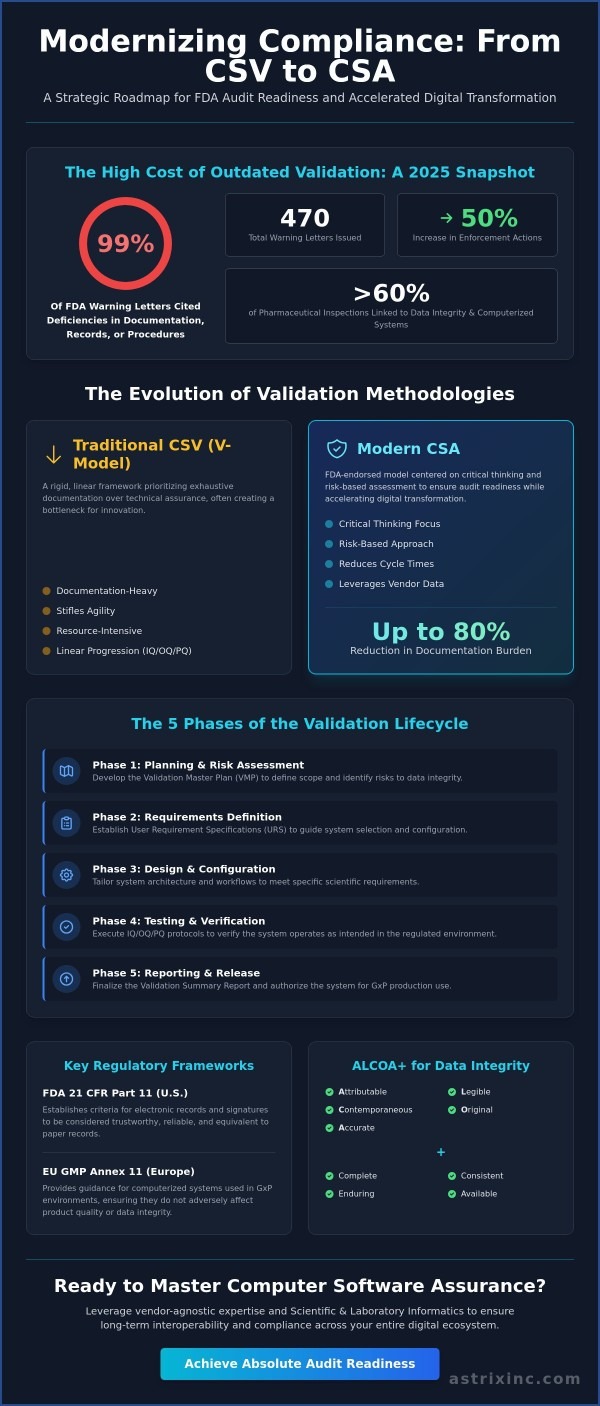
In 2025, the FDA issued 470 warning letters; a staggering 99% of these actions cited deficiencies in documentation, records, or written procedures. This 50% increase in enforcement actions compared to the previous fiscal year highlights a critical vulnerability in how many life sciences organizations approach computer systems validation. You’ve likely experienced how traditional, documentation-heavy validation models often act as a bottleneck, consuming excessive resources while failing to provide true technical assurance. It’s a complex challenge to maintain 21 CFR Part 11 compliance while attempting to accelerate digital transformation in a high-stakes scientific environment.
This guide provides a strategic roadmap to master the February 3, 2026, FDA guidance on Computer Software Assurance (CSA), which officially prioritizes critical thinking and risk-based methodologies over exhaustive paperwork. By adopting these modern frameworks, you’ll achieve absolute audit readiness and reduce validation cycle times without compromising on data integrity. We’ll explore how to leverage vendor-agnostic expertise and Scientific & Laboratory Informatics to ensure long-term interoperability and compliance across your entire digital ecosystem.
Key Takeaways
- Define the critical role of computer systems validation in maintaining technical consistency and ensuring product quality across regulated laboratory environments.
- Evaluate the transition from traditional V-Model methodologies to the risk-based Computer Software Assurance (CSA) model to streamline compliance processes and reduce cycle times.
- Apply the ALCOA+ framework to establish a rigorous standard for data integrity, protecting the reliability and audit-readiness of electronic records and signatures.
- Assemble a high-performing cross-functional team by identifying the specialized technical and regulatory competencies essential for modern validation engineers and subject matter experts.
Foundations of Computer Systems Validation (CSV) in Regulated Environments
Computer systems validation serves as the technical bedrock for safety and reliability within the life sciences sector. It’s defined as the documented evidence providing a high degree of assurance that a specific process or system consistently produce results meeting its predetermined specifications and quality attributes. This isn’t just a software testing exercise; it’s a holistic lifecycle commitment that ensures the digital infrastructure supporting scientific discovery remains accurate and secure. By maintaining this rigorous standard, organizations protect public health and ensure that the data driving clinical decisions remains beyond reproach.
The role of computer systems validation extends into every facet of GxP compliance. It acts as the primary mechanism for verifying that technology serves as a servant to scientific discovery rather than a source of risk. In an era of rapid digital transformation, the strategic roadmap for any laboratory must prioritize validation to maintain the integrity of the scientific process. Without a structured framework, the interoperability of complex informatics systems becomes a liability, potentially compromising the safety of products reaching patients.
Key Regulatory Frameworks: FDA 21 CFR Part 11 and Annex 11
In the United States, FDA 21 CFR Part 11 establishes the criteria under which electronic records and signatures are considered trustworthy and equivalent to paper. This regulation demands strict controls for closed and open systems, including audit trails, authority checks, and device checks. Across the Atlantic, EU GMP Annex 11 provides the European counterpart, emphasizing that the introduction of computerized systems shouldn’t adversely affect product quality or data integrity. A predicate rule is an established FDA requirement that mandates the maintenance of specific records or signatures, which then triggers the application of 21 CFR Part 11 when those records are managed in a digital format.
The Business Imperative: Beyond ‘Checking the Box’
The financial and reputational risks associated with inadequate validation are both quantifiable and accelerating. During the 2025 fiscal year, the FDA issued a total of 470 warning letters, which represented a 73% increase in enforcement actions for the first half of the year compared to 2024. A staggering 99% of these letters contained citations related to documentation, records, or written procedures. Regulatory findings show that more than 60% of recent pharmaceutical inspections are directly linked to data integrity and computerized systems. Investing in robust validation prevents the catastrophic costs of consent decrees and ensures that operational reliability remains a competitive advantage in a high-stakes global market.
Methodologies for Success: From the V-Model to Computer Software Assurance (CSA)
Historically, the life sciences sector has relied on the rigid V-Model to structure its computer systems validation efforts. This traditional framework establishes a linear progression where each requirement phase is mirrored by a corresponding testing phase, typically categorized as Installation Qualification (IQ), Operational Qualification (OQ), and Performance Qualification (PQ). While this approach provides a clear audit trail, it often creates a documentation-heavy environment that can stifle agility and delay the adoption of modern informatics tools. It’s a process that has frequently prioritized the volume of paperwork over the actual quality of the software assurance.
The landscape changed significantly on February 3, 2026, when the FDA released its final guidance on Computer Software Assurance for Production and Quality Management System Software. This guidance encourages a shift from “documenting for the sake of documentation” toward a model centered on critical thinking and objective risk assessment. By prioritizing testing for high-risk functions and leveraging vendor-provided data, organizations can reduce their documentation burden by up to 80% compared to traditional models. This optimization allows laboratory managers to focus resources on the “science of the lab” rather than administrative overhead, ensuring that technology remains an efficient servant to discovery.
The 5 Phases of the Validation Lifecycle
A structured lifecycle ensures that every system remains compliant from inception through operation. This process typically follows five distinct phases:
- Phase 1: Planning and Risk Assessment: Development of the Validation Master Plan (VMP) to define project scope and identify potential risks to data integrity.
- Phase 2: Requirements Definition: Establishing clear User Requirement Specifications (URS) and Functional Specifications to guide system selection.
- Phase 3: Design and Configuration: Tailoring the system architecture and workflows to meet specific scientific requirements.
- Phase 4: Testing and Verification: Executing IQ/OQ/PQ protocols to verify that the system operates as intended within the regulated environment.
- Phase 5: Reporting and Release: Finalizing the Validation Summary Report to authorize the system for GxP production use.
Implementing a Risk-Based Approach
Modern compliance strategies utilize GAMP 5 guidelines to categorize software based on complexity and risk, ranging from Category 3 (non-configured products) to Category 5 (bespoke software). This categorization allows teams to apply the appropriate level of scrutiny to each system, ensuring that validation efforts are proportional to the potential impact on patient safety. Risk assessments dictate testing depth by identifying which specific system functions require rigorous scripted testing and which can be verified through more streamlined unscripted methods. For organizations seeking to modernize their approach, adopting a strategic roadmap for laboratory informatics can ensure that computer systems validation remains a catalyst for innovation rather than a barrier to digital transformation.
Critical Success Factors: Data Integrity and ALCOA+ Principles
Data integrity represents the absolute assurance that scientific information remains accurate, complete, and consistent throughout its entire lifecycle. In the context of computer systems validation, this isn’t a passive state but a result of active technical and procedural controls. When data serves as the foundation for regulatory submissions and patient safety decisions, its reliability must be beyond question. This requires a rigorous focus on the “who, what, when, and why” of every system interaction, captured through secure, time-stamped audit trails that provide a chronological record of all activities.
The cornerstone of this effort is the ALCOA+ framework, which mandates that data must be Attributable, Legible, Contemporaneous, Original, and Accurate. Modern standards extend this to include completeness, consistency, endurance, and availability. Validating complex informatics systems like Laboratory Information Management Systems (LIMS), Electronic Lab Notebooks (ELN), and Clinical Trial Management Systems (CTMS) presents unique challenges. These platforms often manage high volumes of dynamic data across interconnected modules, making the verification of interoperability and data mapping a critical component of the validation strategy.
Achieving ALCOA+ Compliance in the Digital Lab
Regulatory bodies have intensified their scrutiny of technical controls that prevent data from being deleted or obscured. In 2025, over 15% of FDA warning letters included explicit findings such as uncontrolled edits, missing audit trails, or the use of shared user accounts. These failures often stem from inadequate system configuration during the initial validation phase. To mitigate these risks, organizations must implement robust logical security and automated audit trail reviews, ensuring that every change to a GxP record is justified and documented. It’s a technical necessity that transforms raw data into reliable scientific evidence.
Validation in the Era of Cloud and SaaS
The shift toward multi-tenant cloud environments introduces new layers of complexity to the validation lifecycle. Organizations can no longer rely solely on internal controls; they must rigorously evaluate the quality management systems of their software providers. This transition requires comprehensive vendor audits and clearly defined Service Level Agreements (SLAs) to manage the impact of frequent, automated software updates. Integrating these modern platforms is a key driver of Digital Transformation in the Lab, but it demands a vendor-agnostic approach to ensure that compliance isn’t sacrificed for convenience.
Ensuring your informatics ecosystem meets these stringent standards requires deep technical mastery. Partner with Astrix for expert laboratory informatics consulting to secure your data integrity and achieve long-term regulatory resilience.
Executing Your CSV Strategy: Staffing and Resource Management
Successful computer systems validation requires more than just technical knowledge; it demands a strategic alignment of specialized personnel who understand both the scientific workflow and the regulatory framework. The shift toward Computer Software Assurance (CSA) in February 2026 has fundamentally altered the talent profile required for success. Organizations now need professionals who can exercise critical thinking to identify high-risk system functions rather than simply following a rigid documentation checklist. This evolution has made finding the right talent a significant hurdle for many life sciences firms, especially given the technical mastery required to navigate modern informatics ecosystems.
Building a cross-functional team is the most effective way to navigate this complexity. This group should ideally include IT professionals who understand the underlying architecture, Quality Assurance (QA) experts who ensure regulatory alignment, and Subject Matter Experts (SMEs) who utilize the systems in daily laboratory operations. Without this collaborative structure, validation efforts often become siloed. This leads to systems that are compliant on paper but functionally inefficient for the scientists they serve. A well-structured team ensures that technology remains a servant to scientific discovery while meeting the rigorous demands of 21 CFR Part 11.
Essential Skills for the Modern Validation Professional
A modern validation engineer must possess a unique blend of technical proficiency in GxP systems and a granular understanding of current FDA guidance, particularly the 2026 focus on risk-based assurance. Beyond technical expertise, soft skills are equally vital. These professionals act as translators between laboratory scientists and IT departments, ensuring that technical configurations support actual scientific needs. If you’re looking to expand your internal capabilities, understanding how to hire a validation engineer with this specific dual-layered skill set is essential for long-term success.
The Role of Specialized Consulting Partners
Many organizations find that maintaining a full-time, in-house team for large-scale LIMS or CTMS implementations isn’t always feasible or cost-effective. Leveraging specialized staff augmentation or consulting partners allows firms to access deep technical mastery exactly when it’s needed most. A vendor-agnostic partner provides objective oversight, ensuring that the validation strategy isn’t biased toward a specific software provider’s limitations. This approach is particularly valuable when navigating the 73% increase in FDA enforcement actions observed in early 2025, where documentation failures were cited in 99% of warning letters.
Astrix bridges the gap between technical informatics and regulatory compliance by providing the end-to-end oversight required for complex digital landscapes. Your next step should be the development of a multi-year validation roadmap that accounts for system retirements, upgrades, and the integration of new cloud-based platforms. By treating computer systems validation as a continuous lifecycle activity rather than a one-time event, you ensure that your laboratory remains audit-ready and scientifically productive.
Advancing Your Regulatory Resilience and Digital Maturity
The transition from traditional documentation-centric models to the FDA’s risk-based Computer Software Assurance framework represents a fundamental shift in how life sciences organizations must approach compliance. By prioritizing critical thinking and technical controls over administrative volume, firms can maintain the rigorous ALCOA+ standards required to protect public health while accelerating their digital transformation. Effective computer systems validation is no longer a static milestone; it’s a continuous lifecycle activity that demands a sophisticated blend of informatics expertise and regulatory foresight.
With over 25 years of specialized experience in the life sciences sector, Astrix provides the vendor-agnostic strategic consulting and expert staffing necessary to navigate these intricate digital landscapes. We help you build a robust roadmap that ensures your laboratory informatics systems remain interoperable, secure, and fully audit-ready. It’s time to transform your validation process from a resource-intensive bottleneck into a strategic asset that supports scientific discovery. Optimize your validation strategy with Astrix Scientific & Laboratory Informatics services. Together, we can ensure your systems remain as precise as the science they support.
Frequently Asked Questions
What is the difference between CSV and CSA?
The primary distinction lies in the shift from exhaustive documentation to a risk-based assurance model that prioritizes critical system functions. While traditional computer systems validation often results in a 4:1 ratio of documentation to testing, the Computer Software Assurance (CSA) approach promotes unscripted testing and leverages vendor data to reduce administrative overhead. This shift allows teams to focus resources on software features that directly impact patient safety and product quality.
Is Computer Systems Validation a one-time event?
Validation is a continuous lifecycle activity that spans from initial system implementation through eventual retirement. It’s not a static milestone; rather, it requires ongoing maintenance through change control, periodic reviews, and re-validation when system updates or environment changes occur. Maintaining this state of control is essential for ensuring that data integrity remains intact throughout the entire operational life of the informatics platform.
Does the FDA require validation for all laboratory software?
The FDA requires validation for software used as part of production or quality systems as mandated by 21 CFR Part 820.70(i) and 21 CFR Part 11. Systems that don’t impact GxP data, such as basic office productivity tools or non-regulated research platforms, generally don’t require formal validation. Any system that manages, stores, or generates data used for regulatory submissions must undergo a structured validation process to ensure compliance.
What are the common artifacts produced during a CSV project?
A standard project produces a set of core deliverables including the Validation Master Plan (VMP), User Requirement Specifications (URS), and the Traceability Matrix. These are followed by the Installation, Operational, and Performance Qualification protocols (IQ/OQ/PQ) and their respective execution results. The process concludes with a Validation Summary Report (VSR), which provides the final authoritative statement that the system is fit for its intended use in a regulated environment.
How long does a typical LIMS validation project take?
A typical LIMS validation project generally spans between 3 and 9 months, depending on the system’s complexity and the degree of configuration required. Highly customized GAMP Category 5 systems often require longer timelines to account for extensive functional testing and data migration activities. Conversely, out-of-the-box Category 3 solutions can often be validated in shorter cycles by leveraging vendor-provided documentation and a risk-based testing strategy.
Can we use a risk-based approach for legacy systems?
Organizations can and should apply a risk-based approach to remediate legacy systems that were originally validated under less stringent standards. By performing a retrospective gap analysis, teams can identify high-risk areas, such as missing audit trails or inadequate access controls, and focus their remediation efforts where they provide the greatest impact on data integrity. This targeted computer systems validation strategy ensures that older systems meet modern 21 CFR Part 11 requirements without requiring a complete system overhaul.
About Astrix
Over the past 30 years, Astrix has grown into a global team of more than 500 professionals dedicated to advancing science through technology. Today, we proudly support 21 of the world’s top 25 pharmaceutical companies, delivering value every day across scientific operations, data and analytics, regulatory and quality functions, laboratory informatics, clinical development, and enterprise technology initiatives. I want to personally thank our employees, clients, and partners for being integral to our journey. I am excited about what we will achieve together in the years ahead.
Today, life sciences organizations are navigating an unprecedented era of digital transformation. The convergence of data, cloud platforms, and artificial intelligence is redefining how research is conducted, how therapies are developed, and how quality and compliance are maintained. At Astrix, we are proud to help our clients harness these innovations. We work every day to transform complex data into actionable insights, modernize laboratory and clinical systems, strengthen scientific operations, and enable scalable, future-ready technology ecosystems that accelerate innovation and improve business performance.
While technology continues to evolve, our foundation remains the same—putting people first. Our employees and our clients are the driving force behind everything we do. Their expertise, curiosity, and commitment allow us to solve the most complex scientific and technical challenges. Whether implementing AI-driven analytics, optimizing data governance, accelerating digital lab transformation, or helping organizations maximize the value of their technology investments, we bring the experience and perspective needed to turn ambitious goals into measurable results.
We believe that successful transformation is built on trust. Transparency, honesty, and integrity are essential—not only in leadership, but in every client engagement. For decades, we have worked to build trust in the business of science, and that commitment continues as we guide organizations through increasingly complex data, technology, and regulatory landscapes.