

Most organizations have already invested in both EDC (Electronic Data Capture) and CTMS (Clinical Trial Management System) platforms, yet many still struggle to answer a simple oversight question:
When a data quality trend emerges, can you demonstrate who identified it, what action was taken, and when it was resolved?
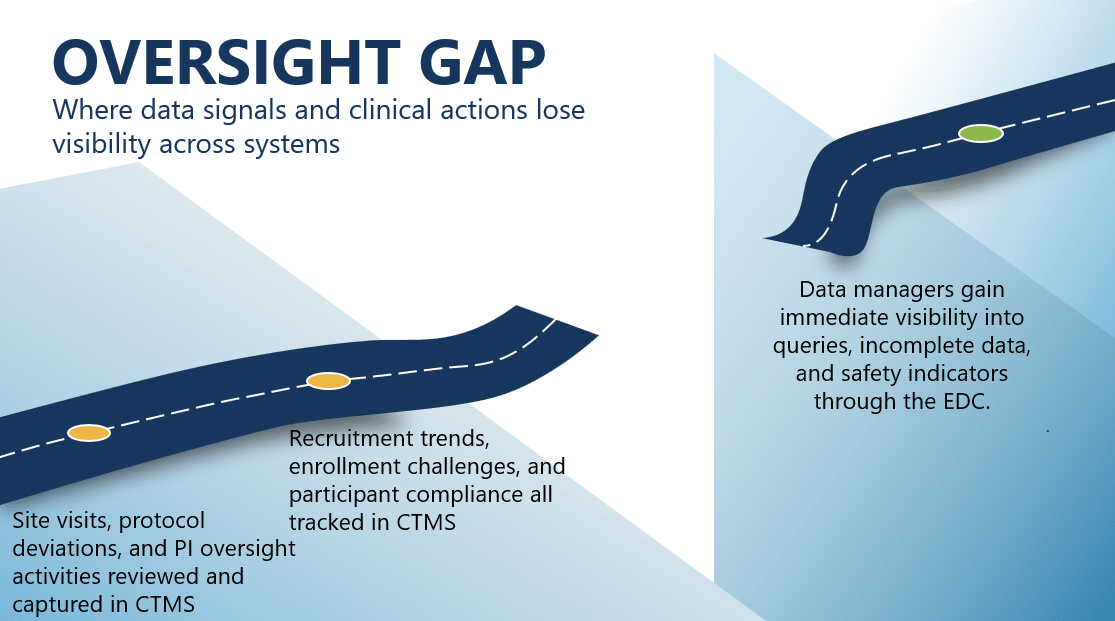
Traditionally, EDC and CTMS operate as parallel workflows. Data management teams review queries, missing data, and safety signals inside EDC, while clinical operations teams track visits, milestones, and trip reports inside CTMS. The result is an oversight gap. CTMS may show monitoring activities were completed, but not whether they addressed the data risks emerging within the trial.
As ICH E6(R3) shifts industry expectations toward risk-proportionate, data-informed oversight1,2, sponsors and CROs need a different operating model. EDC should become the source of operational signals, while CTMS serves as the system of record for oversight decisions, actions, and evidence.
Why EDC Is the Source of Truth for Oversight
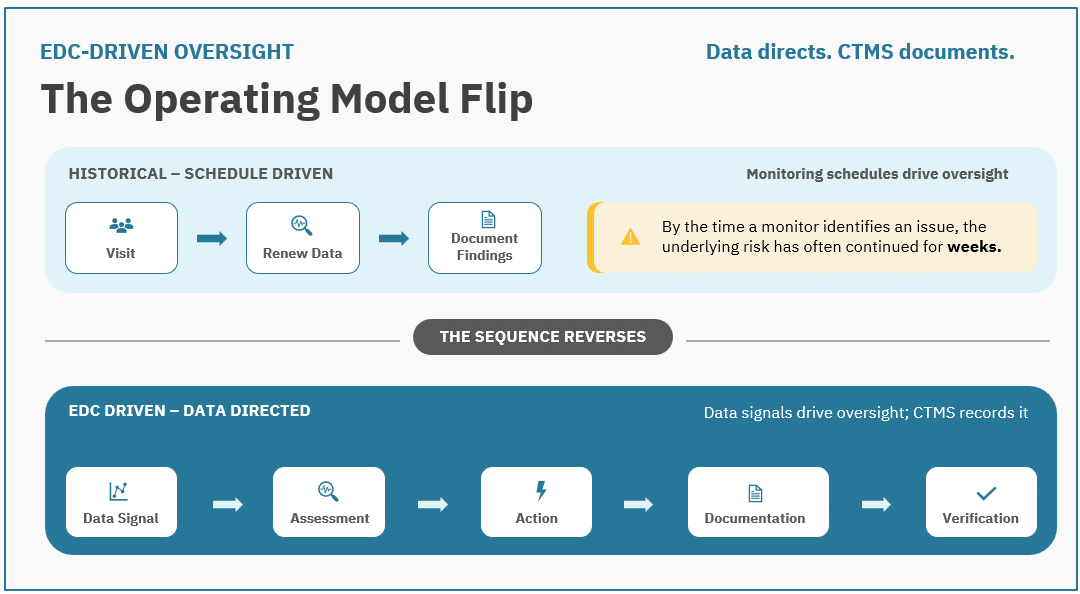
EDC captures the earliest indicators of emerging study risk. Because data flows in as sites enter it, EDC provides a near-real-time view of data quality, protocol compliance, participant safety, and site performance. It often reveals issues weeks before they appear in a monitoring report or inspection finding. EDC therefore detects risk early, while CTMS documents the response.
The Data Capture System Tells a Different Story
EDC captures the earliest indicators of emerging study risk. Data flows in as sites enter it, so EDC offers a near-real-time view of data quality, protocol compliance, participant safety and site performance. It often reveals issues weeks before they appear in a monitoring report or an inspection finding. This potential for detecting significant risks to data quality and protocol compliance provides key signals in EDC, including:
- Query volume and aging
- Data entry lag between visit and entry
- Missing or incomplete forms
- Visit window and eligibility deviations flagged by edit checks
- Out-of-range or atypical values
- Adverse event patterns across sites
- Delays between AE onset and entry, and SAE reconciliation gaps with the safety database
- Early treatment discontinuations and study withdrawals
Individually, each of these signals is a single indicator at a single point in time. Together, they form an early warning system. A growing query backlog at one site, lengthening entry delays, repeated eligibility deviations, or an unusual AE (Adverse Event) pattern all show where oversight attention is needed before an issue becomes a data-quality finding1, 2.
This is what ICH E6(R3) expects. The guideline centers on risk-proportionate quality management focused on critical-to-quality (CTQ) factors1, 2. These CTQs and Quality Tolerance Limits are now, more often, referred to as “acceptable ranges” in the guidance. It also treats centralized monitoring as a core oversight method alongside on-site visits, one that can complement on-site presence, reduce frequency of monitoring, or be used on its own1, 2. Oversight depends on how well teams identify and manage risks to participant safety and the reliability of trial results, not on the volume of monitoring activity.
The evidence supports the approach. An analysis of nine common key risk indicators across 212 studies found that most flagged sites improved after study team follow-up5. A second analysis of 1,111 at-risk sites found quality improved at 83% of sites under central statistical monitoring, versus 56% in historical studies without it6.
Most central monitoring programs combine EDC with eCOA (Electronic Clinical Outcome Assessment), IRT (Interactive Response Technology), central lab and safety data – but EDC remains the backbone. It is the primary source of oversight signals, while CTMS assigns, tracks, and documents the responses. EDC shows where to act; CTMS proves the team did.
The objective is not to review more data. It is to find the signals that matter, then ensure each one triggers a timely, documented, measurable action. That shift from retrospective activity review to signal-driven management is where closed-loop oversight begins.
Where CTMS-to-EDC Integration Fits
This is where CTMS-to-EDC integration becomes foundational. Integrated systems eliminate reconciliation delays and provide real-time visibility into site performance indicators, reducing dependency on manual data collection and outdated spreadsheets. The value of integration is not just efficiency. It is enabling timely oversight decisions.
The Five-Step Closed-Loop Workflow
- EDC identifies a meaningful signal, such as:
- Query backlog exceeds threshold
- Missing forms increase
- Data latency rises
- AE patterns emerge
- Central monitoring and RBQM teams evaluate significance and site impact, weighing likelihood, detectability, and impact on participants and trial results1,2.
- Study managers, CRAs, medical monitors, or data managers implement corrective actions. ICH E6(R3) expects issues to be escalated and followed up in a timely manner1,2.
- CTMS becomes the official record of:
- Issue assignment
- Ownership
- Due dates
- Escalation
- CAPA activities
- Oversight rationale
- EDC confirms whether the action resolved the original signal. Only then is the issue formally closed in CTMS.
This creates a closed-loop oversight framework that directly aligns with ICH E6(R3) Annex 1 quality management requirements (3.10) and modern centralized monitoring expectations (3.11.4.2). The guideline itself asks that sponsor decisions on monitoring findings, and that the resolution of the resulting actions, be recorded1,2. FDA’s risk-based monitoring guidance likewise covers how monitoring results should be addressed and communicated, not only how they are found3.
How Integration Enables the Loop
Bi-directional integration is what keeps these five steps connected. Subject enrollment events, site milestones, query metrics, and monitoring activities move seamlessly between systems rather than requiring manual reconciliation.
What CTMS Must Capture to Close the Loop
To support effective risk-based oversight, CTMS should do more than document monitoring activities. It should serve as the system of record for how risks are identified, assessed, managed, and resolved, preserving a complete evidence trail throughout the lifecycle of an issue.
For each identified risk, the oversight record should capture the originating data signal. For example: query aging exceeding 30 days at Site 104, with 42 overdue queries. The record should also show clear ownership assigned to the appropriate CRA (Clinical Research Associate), study manager, or data manager, and the action plan implemented to address the issue. That plan may include site training, query resolution reviews, focused monitoring visits, or escalation to the sponsor.
Beyond documenting actions taken, CTMS should provide traceability into why the issue occurred by capturing root cause analyses, such as staffing turnover, workflow inefficiencies, or training deficiencies. This should be accompanied by comprehensive CAPA (Corrective and Preventive Action) documentation detailing both the corrective actions performed, and the preventive measures implemented to reduce the likelihood of recurrence. ICH E6(R3) calls for exactly this when noncompliance could significantly affect participants or the reliability of results: root cause analysis, corrective and preventive action, and confirmation that the actions were adequate 1, 2.
Finally, the oversight audit-trail should include objective evidence that the issue has been resolved, such as signals returning to acceptable thresholds, improved EDC metrics, or the elimination of adverse trends over time.
By maintaining this closed-loop documentation, CTMS demonstrates not only that a risk was identified, but also how it was investigated, managed, corrected, and verified as resolved. This level of traceability directly supports ICH E6(R3) expectations for sponsor oversight (3.9) and noncompliance management (3.12) while creating a defensible, inspection-ready record of oversight decisions1, 2. Integration between EDC and CTMS further strengthens this framework by providing a unified audit trail and improving data lineage across systems, ensuring that every signal, decision, action, and outcome can be traced from detection through resolution.
Roles and the Study Team’s Daily Rhythm
An EDC-driven operating model succeeds only when responsibilities are clearly defined.
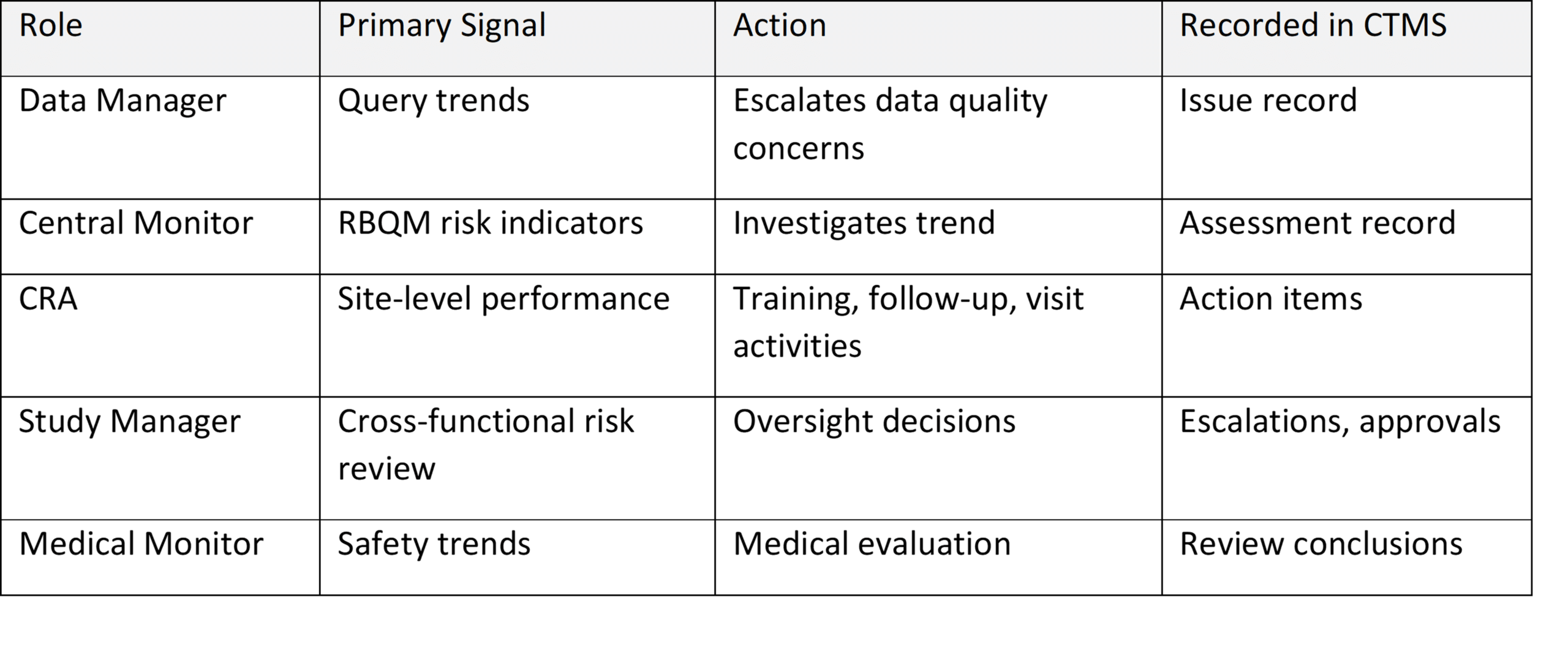
A typical weekly cadence might include:
- Centralized signal review
- Risk prioritization meeting
- CTMS action assignment
- CRA/site follow-up
- EDC confirmation of remediation
- Formal CTMS closure
This operational rhythm aligns with ICH E6(R3) Principle 10, which requires roles and responsibilities to be clear and documented appropriately, and with the expectation that sponsors allocate trial activities before they begin1,2.
Integration and Data Model Prerequisites
Organizations cannot achieve EDC-driven oversight if their systems cannot communicate consistently. Successful implementations rest on four prerequisites.
1. Shared Master Data
EDC and CTMS must use the same identifiers for:
- Studies
- Sites
- Subjects
- Visits
2. Single-Source-of-Truth Rules
Organizations must define where each data element originates. Common examples include:
- Subject status originates in EDC
- Operational milestones originate in CTMS
- Risks originate in RBQM platforms
Clear origin rules support the single-source-of-truth concept necessary for regulatory compliance and operational consistency.
3. Standardized Data Taxonomy
Consistent issue categories, risk ratings, and action classifications should be shared across systems.
4. Automated Data Exchange
Manual rekeying creates unnecessary compliance and quality risks; ICH E6(R3) itself treats data transfer, exchange, and migration as a governed step in the data life cycle1,2. Rather than spreadsheet-driven issue management, modern architecture typically leverage:
- APIs
- Middleware platforms
- Event-driven integrations
- Platform-native integration frameworks
Data Governance Supports Regulatory Compliance and Confidence
Effective data governance provides the foundation for trustworthy clinical and operational decision-making throughout the study lifecycle. By ensuring audit trail integrity, preserving critical metadata, maintaining end-to-end traceability, supporting computerized system validation, and enabling continuous inspection readiness, organizations can demonstrate that study data and oversight activities are complete, accurate, reliable, and defensible. Strong governance practices not only support regulatory compliance but also create confidence that risks, decisions, and actions can be reconstructed and verified at any point during an inspection or audit.
This aligns with the dedicated data governance section of ICH E6(R3), which covers metadata and audit trails, data transfer, and computerized system validation and with its principle that record integrity and traceability be maintained1,2. It also reinforces the ALCOA++ data integrity principles set out in EMA’s guideline on computerized systems and electronic data in clinical trials, through automated synchronization and preserved lineage4.
Measuring the Model
Organizations should measure not only activity completion but also oversight effectiveness. Key KPIs include:
- Query aging
- Query cycle time
- Signal-to-action time
- Issue closure rate
- Repeat findings per site
- Risk recurrence rate
- Quality tolerance limit excursions1,2
- Oversight-related inspection findings
A useful benchmark question is: How long does it take for a signal identified in EDC to become a documented action in CTMS?
Organizations that can answer that question consistently are moving toward true data-driven oversight.
Conclusion
The future of clinical oversight is not built around monitoring schedules or milestone tracking. It is built around data signals, risk evaluation, and documented action.
EDC should identify where attention is needed. CTMS should document how the organization responds.
When these systems operate together within a defined oversight framework, sponsors gain more than operational efficiency. They create a defensible, inspection-ready record demonstrating that risks were identified, assessed, addressed, and verified.
How Astrix Helps
Can your CTMS show the complete path from a data signal to a documented, verified resolution?
Astrix helps sponsors and CROs assess their current-state oversight operating model, then design and implement EDC-driven oversight that turns data into documented action. We connect EDC, CTMS, and RBQM ecosystems, establish governance frameworks, and align SOPs, roles, and workflows to deliver inspection-ready oversight aligned with ICH E6(R3). Connect with our experts to learn more.
About Astrix
Astrix is the global leader in delivering innovative strategies and solutions to the life sciences industry. Powered by world-class people, proven processes, and advanced technology, Astrix partners with clients to drive measurable improvements in business performance, scientific advancement, and clinical outcomes—ultimately driving towards a goal of improving quality of life. Founded by scientists to address the industry’s most complex challenges, Astrix provides a growing portfolio of strategic and technical services that deliver immediate impact while enabling long-term digital transformation. Our deep expertise spans strategic planning, data strategy, AI/ML readiness and technologies, lab informatics, and modern clinical operations and eClinical platforms so we can successfully deliver solutions that have high impact and drive better outcomes for everyone.
References
- International Council for Harmonization (ICH). E6(R3) Guideline for Good Clinical Practice (GCP): Principles and Annex 1. Step 4, 6 January 2025; effective in the EU 23 July 2025. European Medicines Agency
- S. Food and Drug Administration. E6(R3) Good Clinical Practice: Guidance for Industry. September 2025. fda.gov/media/169090/download
- S. Food and Drug Administration. A Risk-Based Approach to Monitoring of Clinical Investigations: Questions and Answers. Guidance for Industry. April 2023. fda.gov
- European Medicines Agency. Guideline on Computerised Systems and Electronic Data in Clinical Trials. ema.europa.eu
- de Viron S, Trotta L, Steijn W, Young S, Buyse M. Does Central Monitoring Lead to Higher Quality? An Analysis of Key Risk Indicator Outcomes. Therapeutic Innovation & Regulatory Science. 2023;57(2):295–303. doi:10.1007/s43441-022-00470-5
- de Viron S, Trotta L, Steijn W, Young S, Buyse M. Does Central Statistical Monitoring Improve Data Quality? Therapeutic Innovation & Regulatory Science. 2024;58(3). doi:10.1007/s43441-024-00613-w