

AI in Life Science – Bridging Science, Data, and Regulatory Compliance
AI in life science is opening new possibilities across drug discovery, clinical development, laboratory operations, and regulatory affairs. Yet moving from a promising pilot to a reliable, scalable capability remains a challenge for many life sciences organizations.
The obstacle isn’t technology alone. Scaling AI requires people who can connect model performance to scientific reality, ensure data is trustworthy and traceable, and establish that AI-generated outputs are appropriate for their intended use.
That combination of expertise is challenging to assemble – and increasingly important as life sciences organizations move AI into more consequential workflows. For organizations facing these challenges, the question is how to access the right scientific, data, and regulatory expertise without necessarily building every capability in-house.
In January 2026, the U.S. Food and Drug Administration (FDA) and the European Medicines Agency (EMA) published ten guiding principles for good AI practice in drug development [1]. Their emphasis on multidisciplinary expertise, data governance, risk-based evaluation, and lifecycle management reinforces a critical point: successful AI depends on more than the model. It depends on the people responsible for developing, evaluating, and overseeing it.
In this article, we look at the expertise gap, what the FDA and EMA principles say, and how a new operating model of humans, AI, and experts working together changes who does what. We close with practical questions to ask before you try to scale AI across a program.
What It Takes to Scale AI in Life Sciences
Life sciences organizations are investing in AI – but scaling AI and realizing meaningful returns remain challenging. One difficulty is not simply finding more AI specialists. It is finding people who can bridge disciplines.
In Deloitte’s 2026 Life Sciences Executive Outlook, based on a survey of biopharma and medtech executives conducted in August and September 2025, only 22% of respondents said they had successfully scaled AI, while just 9% reported significant returns [2]. Deloitte does not attribute this gap to a single cause, and talent is only one part of the equation. However, the findings highlight the difficulty of moving beyond experimentation to production-grade, governed AI.
The broader labor market points to a similar challenge. ManpowerGroup’s 2026 Talent Shortage Survey, covering 39,000 employers across 41 countries, found that AI skills had become the hardest for employers to find globally for the first time. Overall, 72% of employers reported difficulty filling roles [3].
The life sciences industry faces an additional challenge: the need to combine technical capabilities with scientific knowledge and an understanding of regulated environments. A 2025 Pistoia Alliance Annual Lab of the Future Survey found that 34% of respondents cited a lack of people as a barrier to AI adoption, up from 23% in 2024 [4].
A machine learning engineer may be able to build a model but lack the scientific context to judge whether its predictions are biologically plausible. A scientist may understand the underlying biology but lack the data engineering expertise to establish a reproducible, traceable pipeline. And neither may have the regulatory experience needed to assess how AI-generated evidence should be documented and evaluated for its intended use.
Scaling AI requires the right combination of scientific judgment, data expertise, regulatory knowledge, and operational experience. Without that combination, promising pilots can struggle to become reliable capabilities that deliver sustained value.
This is the expertise gap: not a shortage of AI investment, but rather a shortage of people who can bridge the science, the data, and the regulatory standard at the same time.
What Regulatory Expectations Mean for your AI Team
The FDA and EMA’s joint Guiding principles of good AI practice in drug development provide a useful framework for understanding the expertise needed to develop and use AI responsibly.
The principles address AI used to generate or analyze evidence across the drug product lifecycle, including nonclinical and clinical development, manufacturing, and post-marketing activities. The agencies describe the principles as a foundation for future guidance, consensus standards, and international harmonization.
The document is high-level and should not be treated as a substitute for applicable regulations or formal guidance. Nevertheless, its emphasis on scientific expertise, data governance, evaluation, and ongoing oversight has practical implications for how life sciences organizations staff and manage AI initiatives.
Five principles are particularly relevant:
- Define the context of use (Principle 4). Every AI technology should have a clearly defined role and scope. Teams need to understand what a model is intended to do, the decisions it may inform, and its limitations.
- Integrate multidisciplinary expertise (Principle 5). Expertise in both AI technology and its context of use should be involved throughout the technology lifecycle. Scientific, technical, regulatory, and operational perspectives must inform development and implementation – not just final review.
- Establish data governance and documentation (Principle 6). Data provenance, processing steps, and analytical decisions should be documented in a detailed, traceable, and verifiable manner, with appropriate safeguards for sensitive information and consideration of applicable GxP requirements.
- Evaluate performance in context (Principle 8). Risk-based assessments should consider the complete system, including human-AI interactions, using data and metrics appropriate to the intended use.
- Maintain oversight throughout the lifecycle (Principle 9). Risk-based quality management, ongoing monitoring, and periodic reassessment help organizations identify performance changes, including potential data drift.
The FDA’s January 2025 draft guidance, Considerations for the Use of Artificial Intelligence to Support Regulatory Decision-Making for Drug and Biological Products, reinforces the importance of defining the intended context of use and establishing a risk-based approach to assessing model credibility [5]. The framework draws on the agency’s experience reviewing more than 300 submissions with AI and machine learning components, according to the associated Federal Register notice [6].
Together, these documents highlight a common challenge. Organizations need to do more than demonstrate that an AI model produces an output. They need to establish what the model is intended to do, evaluate its performance appropriately, document the evidence supporting its use, and determine how it will be monitored over time.
Each of these activities requires appropriate expertise and clear accountability.
Five Expertise Areas Behind Scalable AI
AI is not simply replacing work in life sciences. It is changing who does what. The most useful way to think about it is as a chain of contributions, each answering a different question, where AI is one link and not the whole chain.
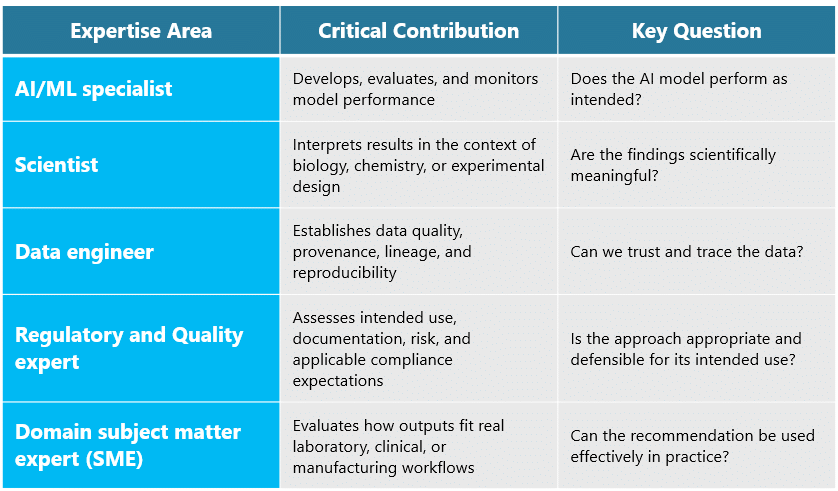
These expertise areas are complementary, and one individual may cover more than one area depending on the initiative. What matters is that the necessary capabilities are represented and that responsibilities are clearly defined.
How these Expertise Areas Work Together
Consider a life sciences organization introducing an AI model into a regulated laboratory workflow:
The AI/ML specialist evaluates whether the model performs as intended. A scientist assesses whether its findings are scientifically plausible and relevant to the experiment. A data engineer establishes the quality, traceability, and reproducibility of the underlying data. A regulatory or quality specialist assesses the documentation, validation, and oversight expectations applicable to the intended use. Meanwhile, a laboratory SME evaluates whether the proposed workflow fits existing procedures and whether staff can appropriately review and act on the results.
These responsibilities are interconnected rather than sequential handoffs.
For example, a model may perform well on a test dataset but produce questionable results when applied to a different experimental context. Scientific expertise can identify the problem. Data engineering can help determine whether differences in data collection or processing contributed to it. The AI/ML specialist can investigate model performance, while regulatory and quality professionals assess the implications for the intended use and any necessary reassessment.
Without this collaboration, a technically promising solution may prove difficult to reproduce, validate, integrate, or maintain.
The lesson is straightforward: AI can identify patterns and generate predictions, but people with the right expertise determine what those outputs mean, whether they can be trusted, and how they should be used.
Closing the Gap: Match the Expertise to the Complexity
The expertise needed to scale AI is scarce, and demand for individual specialties can change significantly as a program evolves.
A computational biologist may be needed to evaluate a particular discovery program. A scientific data engineer may be essential when establishing trusted, traceable data pipelines. A regulatory or quality specialist may be required to assess documentation, validation, and compliance expectations for a specific use case.
These needs may be intensive during one phase of a program and more limited during another. Hiring a full permanent team across every specialty can be slow and impractical, particularly when the workload is variable, or a capability is needed for a defined period.
The challenge is accessing the right expertise when it is needed – and ensuring those specialists can work effectively with existing teams.
Astrix Expert Services helps life sciences organizations access specialized expertise aligned to their program needs, timelines, and complexity. Flexible engagement models – including fractional, embedded, on-demand, retainer-based, and direct-hire options – give organizations different ways to address capability gaps and adapt resources as priorities evolve.
Expertise spans several areas critical to life sciences AI and digital transformation:
- Discovery and computational science: computational biologists, AI/ML modelers, bioinformaticians and data engineers who can support work ranging from discrete preclinical data challenges to leading broader computational science initiatives.
- Clinical: clinical data management SMEs, clinical operations process experts, and clinical systems specialists with experience in platforms such as Veeva and Medidata.
- Regulatory: eCTD publishing, RIM and IDMP specialists, and full CMC section authoring and strategy.
- Quality and compliance: QMS design, GxP compliance and remediation, and validated systems support where audit readiness is non-negotiable.
For broader initiatives, Expert Services can complement Astrix’s AI and Machine Learning and Data Management Services, connecting specialized talent with wider technology and transformation needs.
The objective is not simply to fill a role. It is to put the appropriate expertise in place to help teams execute their programs effectively, manage complexity, and build the capabilities needed to move forward successfully.
Five Questions to Ask Before You Scale AI
Before expanding an AI initiative beyond a pilot, life sciences leaders should assess whether the necessary expertise and accountability are in place.
1. Is the intended use clearly defined?
Can the team explain what the model is designed to do, its limitations, and where human oversight is required?
2. Can we validate the science?
Is there a qualified expert who can interpret the outputs, challenge questionable findings, and determine whether the results are scientifically meaningful?
3. Can we trust and trace the data?
Are data provenance, processing steps, and analytical decisions documented and reproducible? Can the team demonstrate how the data supports the intended use?
4. Are risk and regulatory expectations addressed?
Have the appropriate regulatory and quality experts assessed the requirements for the intended use, including relevant documentation, validation, and oversight?
5. Who owns ongoing oversight?
Is there a plan for monitoring performance, evaluating changes, and reassessing the system over time?
If the answers are unclear, identify the missing capabilities before expanding the program. In some cases, the solution may be to develop internal skills. In others, bringing in specialized expertise can help close the gap.
These questions provide a starting point for assessing whether an organization has the people, processes, and accountability needed to move AI from experimentation toward sustainable use.
Ready to Close Your Expertise Gap?
Moving AI from pilot to practice takes more than the right technology. It takes the scientific judgment, trusted data, and regulatory and operational expertise to put that technology to work.
As AI initiatives evolve, organizations need access to the right capabilities at the right time – without necessarily building every specialty in-house.
Astrix Expert Services helps life sciences organizations access specialized expertise aligned to their needs.
Explore our Expert Services or contact our team to discuss the expertise your next initiative requires.
References
- EMA and FDA. “Guiding principles of good AI practice in drug development.” January 2026. https://www.ema.europa.eu/en/news/ema-fda-set-common-principles-ai-medicine-development-0
- “2026 Life Sciences Executive Outlook.” September 2025. https://www.deloitte.com/us/en/insights/industry/health-care/life-sciences-and-health-care-industry-outlooks/2026-life-sciences-executive-outlook.html
- “2026 Talent Shortage Survey.” February 2026. https://www.manpowergroup.com/en/insights/2026-global-talent-shortage
- Pistoia Alliance. “Annual Lab of the Future Survey.” August 2025. https://pistoiaalliance.org/news/survey-ai-adoption-life-sciences-labs-skills-gap/
- S. Food and Drug Administration. “Considerations for the Use of Artificial Intelligence To Support Regulatory Decision-Making for Drug and Biological Products.” January 2025. https://www.fda.gov/regulatory-information/search-fda-guidance-documents/considerations-use-artificial-intelligence-support-regulatory-decision-making-drug-and-biological
- S. Federal Register. “Notice of Availability of Draft Guidance on the Use of Artificial Intelligence to Support Regulatory Decision-Making for Drug and Biological Products.” January 2025. https://www.govinfo.gov/content/pkg/FR-2025-01-07/pdf/2024-31542.pdf