
Implementing a modern Laboratory Information Management System (LIMS) can help laboratories reduce manual data handling, standardize workflows, improve traceability, and streamline reporting. The magnitude of these benefits depends on the laboratory’s starting processes, system configuration, and integration requirements. Laboratory leaders often find themselves managing the escalating maintenance costs of legacy systems while simultaneously weighing the security implications of migrating GxP-critical data to a hosted environment.
This cloud vs on-premise LIMS guide compares LIMS deployment models and examines how each can support data integrity, security, and applicable regulatory requirements. On-premise, hosted, private cloud, and Software as Service (SaaS) deployments offer different combinations of control, scalability, and operational responsibility. The decision to maintain internal servers versus adopting a scalable subscription model requires a sophisticated understanding of organizational technical maturity. The right choice depends on your laboratory’s requirements, existing infrastructure, integration needs, and applicable GxP obligations.
This guide compares the key trade-offs between LIMS deployment models and provides a practical framework for evaluating cost, compliance, security, and long-term scalability. Use it to identify the questions to ask vendors and determine which approach best aligns with your laboratory’s operational and scientific goals.
Key Takeaways
- Compare the deployment models: Understand the differences between on-premise, hosted, private cloud, and SaaS architectures.
- Evaluate regulatory responsibilities: Assess applicable electronic records, data integrity, validation, and supplier oversight requirements.
- Calculate total cost of ownership: Include implementation, integration, validation, infrastructure, staffing, upgrades, and exit costs.
- Test scalability and resilience: Evaluate actual performance, recovery capabilities, instrument connectivity, and multi-site requirements.
- Use a structured selection framework: Compare vendors against your laboratory’s technical, operational, financial, and regulatory needs to select the deployment model that best balances regulatory risk with long-term operational scalability.
The Evolution of Laboratory Data Infrastructure: Contextualizing the LIMS Deployment Debate
The laboratory environment has shifted away from the monolithic, siloed systems that defined the previous decade. Laboratories are modernizing their data infrastructure and informatics workflows. Deployment decisions affect laboratory operations, IT costs, data governance, and regulatory oversight, and many laboratories are prioritizing secure data access, integration, and collaboration across sites.
Defining On-Premise, SaaS, and Private Cloud Architectures
The technical nuances between deployment models dictate the long-term operational burden on IT departments. On-premise installations involve hosting software on internal servers, granting absolute control over the environment but requiring significant capital for hardware and local maintenance.
On-premise LIMS deployments run on infrastructure managed within an organization’s own environment. Hosted deployments run on infrastructure operated by an external provider, while SaaS solutions are delivered and maintained by a provider through a subscription service. SaaS environments may be multi-tenant or single-tenant. Private cloud refers to cloud infrastructure dedicated to a single organization, while IaaS and PaaS describe cloud service models that offer different levels of infrastructure and platform management. The actual division of responsibilities depends on the vendor’s architecture and service agreement.
The Drivers of Change: Why Laboratories are Migrating
Several catalysts are accelerating the departure from legacy systems. Many organizations currently face the “End of Life” (EoL) reality for decade-old on-premise platforms that no longer receive security patches or regulatory updates. This technical debt hinders the move toward real-time remote collaboration. Strategic leaders now view infrastructure choice as a foundational element of their laboratory digital transformation.
Migrating to cloud-native solutions can simplify access to scalable computing resources and centralized data, supporting advanced AI-driven analytics and automated workflows. However, laboratories should also account for lifecycle cost, resilience, scalability, and long-term research needs.
Adopting a platform-neutral perspective is essential for effective strategic consulting in the life sciences. It ensures that the chosen architecture serves the specific scientific objectives and regulatory profile of the laboratory rather than following industry trends blindly. Whether an organization chooses the high-control environment of an on-premise system or the high-agility model of the cloud, the decision must be rooted in a quantitative analysis of risk, compliance, and long-term scalability.
Technical Architecture and Regulatory Compliance: Security, Validation, and FDA Standards
The technical architecture of a laboratory informatics system directly dictates its regulatory posture. A rigorous comparison of LIMS deployment options requires a deep understanding of how infrastructure choices impact data integrity and the maintenance of a validated state. Central to this is the FDA 21 CFR Part 11 regulation, which mandates that electronic records and signatures remain as reliable as their paper counterparts.
Regardless of deployment model, laboratories must maintain data integrity and comply with applicable regulatory requirements. ALCOA+ principles – attributable, legible, contemporaneous, original, accurate, complete, consistent, enduring, and available – can help guide data-integrity practices. Compliance with 21 CFR Part 11 depends on the system’s intended use, applicable requirements, technical controls, and operating procedures, not on where the system is hosted.
Disaster recovery and business continuity planning also diverge based on the selected architecture. Cloud and on-premise deployments can both support effective disaster recovery and business continuity, but their capabilities depend on architecture, configuration, and operational practices. When evaluating a cloud LIMS, review documented backup and restoration procedures, recovery time and recovery point objectives (RTO and RPO), geographic redundancy where applicable, and service-level commitments. For on-premise deployments, assess equivalent capabilities, including off-site backups, recovery testing, and the resources required to restore operations.
Regardless of the model, ensuring the system remains in a state of control is paramount. For organizations struggling to align these technical requirements with industry mandates, engaging expert regulatory and compliance services can provide the necessary oversight to mitigate risk.
The Validation Burden: SaaS vs. On-Premise
Cloud deployment can change how organizations perform computer system validation and assurance and manage software changes. SaaS providers may supply testing documentation, release notes, and other evidence that supports the customer’s risk-based assessment. The regulated organization remains responsible for determining whether the system is fit for its intended use, evaluating relevant changes, and maintaining appropriate oversight throughout the system lifecycle. Risk-based practices described in applicable guidance and GAMP 5 can help organizations focus assurance activities on patient safety, product quality, and data integrity.
Cybersecurity and Data Sovereignty in the Life Sciences
Both on-premise and cloud environments require a documented, risk-based security strategy. Cloud providers may offer security capabilities that would be costly to build internally, but effectiveness depends on implementation, oversight, and the services contracted. These capabilities vary by service and contract and should be verified during supplier assessment.
Organizations should evaluate encryption in transit and at rest, identity and access controls, audit logging, vulnerability management, incident response, backup and recovery, and applicable data-location and cross-border transfer requirements. No single security report or technical control establishes that a LIMS is secure or compliant for every intended use. This level of granular control, combined with proactive threat monitoring, often exceeds the capabilities of localized IT departments managing on-premise hardware.
Strategic Evaluation Framework: Total Cost of Ownership (TCO) and Operational Scalability
Developing a robust comparison of LIMS deployment models requires looking beyond initial licensing fees to evaluate the long-term financial impact on the organization. A comprehensive five-to-seven-year TCO analysis typically involves a rigorous multi-step process outlined in the table below:
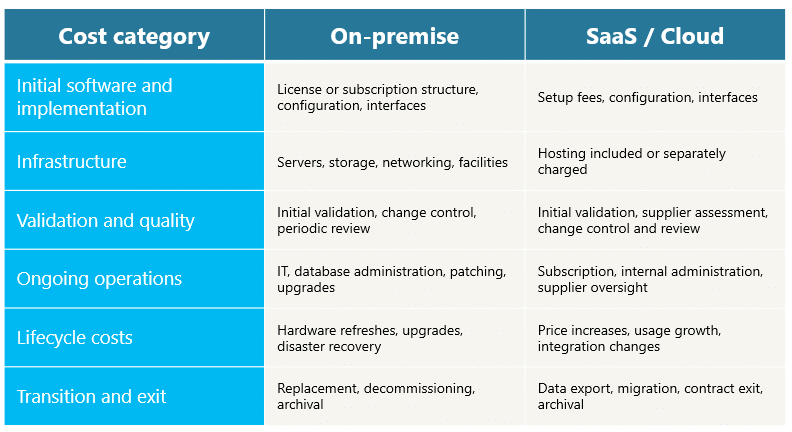
First, organizations must assess initial procurement and server hardware costs. Second, they must quantify the implementation and validation efforts required for GxP compliance. Third, leadership should project annual maintenance and infrastructure overhead. Fourth, the model must account for specialized personnel requirements. Additionally, the framework must plan for hardware refresh and major version upgrade cycles. While on-premise systems demand significant Capital Expenditure (CapEx), cloud models typically shift more costs to recurring operating expenses, which can reduce upfront infrastructure investment. However, organizations should account for subscription changes, usage-based charges, implementation costs, and contract terms when forecasting long-term expenditure.
On-premise installations carry substantial hidden costs that extend beyond the software itself. These include the physical footprint within a facility, dedicated cooling systems, and the significant electricity required to power server banks 24/7. These environmental factors impact the bottom line but are frequently omitted from initial budget discussions.
Organizations must also decide between maintaining internal Database Administrators (DBAs) or leveraging external managed services to ensure system health and data integrity. To optimize your informatics strategy and ensure a positive return on investment, engaging specialized strategic consulting services can help clarify these financial projections.
Scalability and Elasticity: Responding to Research Growth
For laboratories handling high-throughput screening or large-scale genomic data, cloud models can provide greater elasticity when the underlying architecture supports dynamic scaling. If research demands suddenly spike, cloud infrastructure scales almost instantly to accommodate the increased data volume.
Cloud infrastructure can often be provisioned more quickly than new on-premise hardware, provided the application supports scaling and required capacity is available. Actual performance depends on architecture, licensing, integration complexity, and network connectivity.
Maintenance, Upgrades, and the Cost of Downtime
The approach to system updates represents a fundamental difference between the two architectures.
SaaS providers generally manage application updates and underlying infrastructure maintenance, but release schedules, customer notification periods, configuration options, and the handling of regulated changes vary by vendor. Organizations should understand how updates are tested, communicated, assessed for impact, and incorporated into their change-control and assurance processes.
On-premise deployments may offer greater control over upgrade timing but can require additional internal effort for testing, implementation, and ongoing support. As a result, on-premise systems often remain in a “frozen” state for years to avoid the high cost and operational risk of re-validation. This often leads to “version-lock,” where highly customized systems cannot be upgraded without breaking critical integrations.
A dedicated LIMS administrator is vital for managing these cycles. They ensure the system evolves alongside changing FDA regulations while minimizing the risk of unplanned downtime that can derail critical research timelines.
Navigating the Transition: Selecting the Optimal Deployment Model
Selecting the correct infrastructure requires a synthesis of the technical, financial, and regulatory factors analyzed in the preceding sections. A comprehensive comparison of cloud and on premise-LIMS deployment options isn’t a binary choice but rather a spectrum of control versus agility. Decision-makers must evaluate their laboratory’s specific risk profile and technical maturity to determine which model supports long-term scientific objectives. This selection process often benefits from the oversight of a platform-neutral informatics consulting partner who can provide objective analysis without vendor bias.
Before finalizing a deployment strategy, leadership should utilize a rigorous checklist to evaluate vendor infrastructure claims. Platform architecture, supplier controls, and operating procedures should all support the applicable GxP requirements. Key evaluation criteria include:
- Review the scope and findings of the vendor’s SOC 2 Type II report and verify any applicable ISO 27001 certification.
- Evaluate documented backup, restoration, disaster recovery, and failover capabilities against your laboratory’s recovery requirements.
- Document the division of responsibilities for security, system configuration, data integrity, change control, and applicable GxP obligations.
- Assess API availability, instrument connectivity, data portability, and the effort required to support future integrations.
- Confirm how software updates are communicated, assessed, tested, and managed within your quality system.
When to Choose On-Premise (or Private Cloud)
There are specific scenarios where air-gapped security or extreme customization remains non-negotiable. Organizations with existing, robust IT infrastructure and significant sunk costs in local data centers may find the on-premise model more financially viable in the short term. Additionally, laboratories dealing with extreme high-volume data streaming, such as those utilizing high-resolution imaging or complex proteomics should assess data volume, transfer frequency, latency, network capacity, and instrument connectivity to determine whether local processing, cloud processing, or a hybrid architecture is most suitable.
When to Choose Cloud-Native LIMS
Cloud-native architectures can offer advantages for multi-site organizations and virtual biotechs that require rapid deployment and global data accessibility. These systems eliminate the need for local hardware maintenance, allowing scientific teams to focus on discovery rather than server uptime.
Cloud deployment can also facilitate centralized data integration and analytics. By centralizing data in a structured, scalable environment, organizations can more easily implement advanced AI analytics and predictive modeling. However, AI readiness also depends on data quality, interoperability, governance, and suitable architecture. A cloud LIMS alone does not create AI readiness.
Ultimately, the right choice depends on your organization’s specific scientific data strategy. Whether you opt for the localized control of an on-premise system or the elastic scalability of the cloud, the infrastructure must serve as a reliable tool for discovery and regulatory adherence. Aligning your deployment model with your long-term research goals ensures that your laboratory informatics ecosystem remains a foundational asset for scientific advancement.
Future-Proofing Your Laboratory Informatics Ecosystem
Choosing the right LIMS deployment model is a strategic decision that impacts laboratory operations, total cost of ownership, data security, and regulatory compliance. The best approach depends on your organization’s scientific goals, technical requirements, and GxP obligations. By carefully evaluating the trade-offs between cloud and on-premise solutions, laboratories can select an architecture that supports current needs while providing flexibility for future growth.
With more than 30 years of experience in laboratory informatics, Astrix provides vendor-neutral consulting to help life sciences organizations make informed LIMS decisions. Our experts understand the technical, operational, and regulatory considerations involved in selecting and implementing solutions that support data integrity, scalability, and long-term value.
Explore our LIMS Selection and Implementation Services to develop a deployment strategy aligned with your laboratory’s needs, regulatory requirements, and long-term goals.
Frequently Asked Questions
Is a cloud-based LIMS FDA 21 CFR Part 11 compliant?
A cloud-based LIMS can support compliance with applicable FDA 21 CFR Part 11 requirements, but cloud deployment alone does not establish compliance. Organizations should assess the system’s intended use, applicable predicate rules, access controls, audit trails, electronic signatures, record retention, and data-integrity controls. They must also establish appropriate procedures, perform applicable validation or assurance activities, and maintain oversight of the service provider throughout the system lifecycle.
How does the cost of on-premise LIMS compare to SaaS over 5 years?
Evaluating the long-term cost of a Laboratory Information Management System (LIMS) requires looking beyond software licensing to consider the total cost of ownership (TCO) over the system’s operational lifecycle. On-premise deployments typically involve greater upfront investment in software licensing, server infrastructure, implementation, and IT resources. Cloud-based SaaS deployments generally reduce initial infrastructure costs by shifting more expenses to recurring subscription fees, although implementation, integration, data migration, and validation activities can still represent significant investments.
Over time, the relative cost of each model depends on factors such as user volume, licensing terms, infrastructure requirements, internal support resources, upgrade frequency, and service-level agreements. On-premise solutions may incur additional costs for hardware maintenance, software support, and infrastructure refreshes, while SaaS solutions may involve ongoing subscription increases, premium services, or charges for additional users and capabilities. Rather than assuming one model is inherently less expensive, life sciences organizations should compare projected costs over a consistent period – typically five to seven years – and account for both direct expenses and internal resources. This approach provides a more reliable basis for choosing a LIMS deployment model that aligns with operational needs, regulatory requirements, and long-term budget priorities.
What is the “Shared Responsibility Model” in cloud LIMS security?
The Shared Responsibility Model is a security framework that divides operational duties between the cloud provider and the life sciences organization. The provider manages the security of the cloud, including physical data centers and underlying network infrastructure. The laboratory remains responsible for security “in” the cloud, which encompasses data classification, user access management, and maintaining the validated state of the application according to GxP requirements.
Can I migrate my data from an on-premise LIMS to the cloud?
Yes. Data migration from legacy on-premise systems to the cloud is common, though it requires a rigorous validation strategy to ensure data integrity. Migration complexity depends on the legacy system, data structures, interfaces, and regulatory requirements. A migration plan should define how records, metadata, audit trails, attachments, and relevant relationships will be transferred or retained. The process involves mapping existing data structures to the new schema and utilizing Extract, Transform, Load (ETL) protocols. Organizations should document the migration approach, assess data integrity risks, and verify that records remain complete, accurate, traceable, and accessible for their intended use. Where legacy records cannot be migrated with their full context, an appropriate retention and retrieval strategy may be necessary.
Does a cloud LIMS require a dedicated internal IT team?
Cloud-native LIMS deployments significantly reduce the need for internal IT resources focused on hardware and server maintenance. While you won’t need dedicated database administrators for physical server upkeep, your organization still requires personnel focused on system configuration and regulatory alignment. A dedicated LIMS administrator or a specialized informatics partner is usually necessary to manage user workflows, updates, and ongoing compliance with shifting industry standards.
How does internet downtime affect cloud-based LIMS operations?
Internet connectivity is critical for cloud LIMS operations, as a loss of access will temporarily halt data entry and retrieval. Laboratories can reduce the risk of connectivity-related interruptions by implementing redundant internet service providers or utilizing SD-WAN technology to ensure continuous uptime. Some modern platforms also offer limited offline capabilities that allow for localized data caching, which synchronizes with the main database once a stable connection is re-established.
About Astrix
Astrix is the global leader in delivering innovative strategies and solutions to the life sciences industry. Powered by world-class people, proven processes, and advanced technology, Astrix partners with clients to drive measurable improvements in business performance, scientific advancement, and clinical outcomes—ultimately driving towards a goal of improving quality of life. Founded by scientists to address the industry’s most complex challenges, Astrix provides a growing portfolio of strategic and technical services that deliver immediate impact while enabling long-term digital transformation. Our deep expertise spans strategic planning, data strategy, AI/ML readiness and technologies, lab informatics, and modern clinical operations and eClinical platforms so we can successfully deliver solutions that have high impact and drive better outcomes for everyone.