

Over the past several years Astrix delivery teams and our partners have approached Decentralized Clinical Trials (DCTs) with cautious optimism. While the decentralization model showed real promise – particularly during and after the pandemic – empirical evidence to support the industry’s enthusiasm has historically lagged.
That validation has now arrived. A May 2026 study by the Tufts Center for the Study of Drug Development and Science 37 examined 28 trials that paired a direct-to-patient (DTP) virtual site with conventional sites.[5] The results were compelling: DTP sites enrolled roughly six times as many participants as the average traditional site, completed studies at a rate of 86.3% versus 35.7%, and reached database lock approximately four months faster; all while enrolling a notably higher share of women and Black or African American participants.[5]
When decentralization is built as a genuine access model rather than bolted onto a traditional protocol, it moves recruitment, retention, diversity, and timelines all at once. Regulators have finalized the rules, independent research has stress-tested the promises, and the solution market has continued to develop and expand. [2]
What’s left is a more disciplined question: which capabilities, applied where, deliver – and how do you operationalize them under the new regulatory framework? Three key developments since the post-pandemic DCT era help answer that question.
Key Takeaways
- Decentralized trials have moved from experimental to expected: FDA’s 2024 guidance and ICH’s E6(R3) now build decentralized elements into standard GCP compliance, not innovation add-ons.
- The evidence is mixed on partial adoption (single-element “DCT” trials perform no better than traditional ones) but decisive on full commitment: direct-to-patient models can boost enrollment and more than double completion rates.
- The path forward is precision, not more pilots: map your protocols honestly, treat E6(R3) as your design brief, and rationalize data collection before adding new capture technology.
1. The definition is no longer a moving target
As DCTs have evolved post-pandemic, Astrix experts have noted that the industry definition of DCTs was more complex than the FDA definition suggested. That ambiguity has largely been resolved. The FDA finalized Conducting Clinical Trials With Decentralized Elements in September 2024, replacing the language of “decentralized clinical trials” with the more accurate framing of decentralized elements layered into an otherwise conventional trial. The final text also clarified investigator responsibilities, local healthcare provider roles, and how digital health technologies (DHTs) fit into the data flow.[1]
Then ICH finalized E6(R3) Good Clinical Practice in January 2025, which the FDA subsequently adopted as final guidance in September 2025.[2][3] E6(R3) is the more consequential document for operations leaders. It builds decentralized elements, digital health technologies, and computerized systems into the core GCP framework rather than treating them as exceptions. Importantly, it also pairs flexibility with a firm expectation of quality by design, proportionate risk-based oversight, and fit-for-purpose data collection.
The practical implication: DCT capabilities are now a normal part of GCP compliance, not an innovation program that sits beside it. Your SOPs, vendor qualification, and data governance need to reflect that.
2. The evidence is in, and it is more nuanced than the hype
The drive to establish capabilities cannot come at the expense of measuring meaningful impact. Now that the research community has analyzed the data, the true picture is mixed.
A 2025 analysis in npj Digital Medicine revealed that the number of trials using decentralized elements rose roughly 50% between 2019 and 2021, fell sharply in 2022 and then returned to pre-pandemic levels by 2023. Almost all “decentralized” trials were hybrid. 78% implemented only a single decentralized element, and study completion rates were statistically indistinguishable from traditional trials (82.4% versus 83.3%). Oncology, the largest trial category, accounted for less than one percent of decentralized studies.[4]
While sobering, these findings confirm a position we argued in 2023: bolting one element onto a traditional protocol does not change the patient experience or the economics. Decentralization only pays off when it is designed across the full spectrum of capabilities, with the goal of reducing patient burden while enhancing direct data capture and sponsor and CRO oversight.
3. Where it does work, it works dramatically
As noted in the introduction, the counterpoint comes from a May 2026 study by the Tufts Center for the Study of Drug Development and Science 37, which examined 28 trials that used a direct-to-patient (DTP) virtual site alongside conventional sites.[5] DTP sites enrolled roughly six times as many participants as the average traditional site, with screen-failure rates essentially identical (40.4% versus 39.6%).[5] Completion rates were 86.3% at DTP sites compared with 35.7% at traditional sites.[5] Cycle time from first patient visit to database lock was about four months shorter.[5] And the DTP sites enrolled a materially higher share of women and Black or African American participants than the benchmark.[5]
Read the two studies together, and the lesson is clear. Sprinkling a telehealth visit into a site-based protocol does little. Building a genuine patient-centered access model – what we refer to as the “least common” end of digital patient enablement – moves recruitment, retention, diversity, and timelines all at once.
4. Fit-for-purpose data is the new battleground
In 2023, we observed that as sponsors move across the DCT spectrum, “the clinical data landscape expands in breadth and complexity”, and we urged clients to simplify platforms and reduce the volume of data capture. That advice has since been quantified. A 2025 TransCelerate and Tufts CSDD analysis of 105 Phase 2 and 3 protocols found that Phase 3 studies now generate an average of nearly six million data points; that roughly one-third of procedures do not directly support a primary or secondary endpoint; and that these lower-value procedures account for 25–30% of the burden on participants and sites.[6]
E6(R3) explicitly endorses collecting only the data that matters. For decentralized designs, this is not optional: every extra wearable stream, questionnaire, or home-health visit is a retention risk. Organizations getting this right pair DCT enablement with a hard look at protocol design and a digital protocol or schedule-of-assessments approach that automates workflows rather than adding to them. This volume of data requires a thoughtful data governance and analytics strategy to reduce noise and surface clinical endpoints during pivotal phase trials.
5. The market is still growing
None of these have slowed investment. Research and Markets estimates the global DCT market at about $10.3 billion in 2026, growing to roughly $19.6 billion by 2030, a compound annual growth rate above 17%.[7] The drivers are familiar from our trends analysis: hybrid models, AI-driven trial optimization, remote monitoring and wearable data, and increasing regulatory acceptance. The vendor landscape remains crowded, which means the “which capabilities, from which partners” question Astrix helps clients answer is as relevant as ever.
What does this mean for adoption?
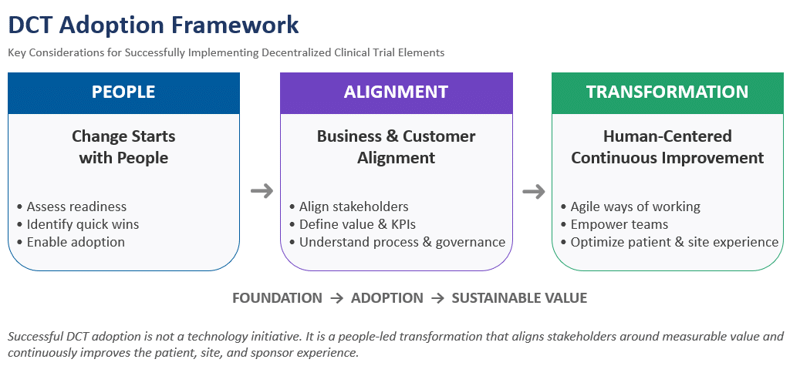
Our adoption framework – think people first, align across the business and the customer, and treat change as a way of working – has held up well. What the last two years have added is precision – knowing exactly where to aim. Based on our current client work, we would emphasize five moves:
- Map your protocols to the DCT spectrum and be honest about how many decentralized elements you use. One element is not a strategy.
- Treat E6(R3) as the design brief. Build risk-based quality management, computerized-system validation, and fit-for-purpose data collection into DCT enablement from the start.
- Pilot a full patient-access model, such as a DTP or virtual site, in a study where recruitment or diversity is a known constraint and measure it against a traditional benchmark.
- Rationalize the data. Use protocol-optimization findings to remove non-core procedures before you add remote capture technology.
- Define success metrics up front, for patients, sites, and the sponsor, and report them. Regulators, investigators, and patients are all asking for evidence, not intent.
The Bottom Line
Three years ago, the question was whether decentralized trials could work. Today, the evidence answers a sharper question: which decentralized elements create value for which trial and population, and why operating models need to be rebuilt so those elements can scale. The sponsors and CROs seeing results aren’t the ones with the most decentralized elements; they’re the ones who have built the governance, data discipline, and change-management foundation to support the elements that matter.
As a technology-agnostic partner, Astrix helps sponsors and CROs to assess DCT readiness, select and integrate the right capabilities, and build the governance and change-management foundation that E6(R3) now expects. If you’re ready to move to a repeatable framework for decentralized and remote monitoring capabilities, contact us to schedule a DCT readiness consultation.
About Astrix
Astrix is the global leader in delivering innovative strategies and solutions to the life sciences industry. Powered by world-class people, proven processes, and advanced technology, Astrix partners with clients to drive measurable improvements in business performance, scientific advancement, and clinical outcomes—ultimately driving towards a goal of improving quality of life. Founded by scientists to address the industry’s most complex challenges, Astrix provides a growing portfolio of strategic and technical services that deliver immediate impact while enabling long-term digital transformation. Our deep expertise spans strategic planning, data strategy, AI/ML readiness and technologies, lab informatics, and modern clinical operations and eClinical platforms so we can successfully deliver solutions that have high impact and drive better outcomes for everyone.
References
- S. Food and Drug Administration. Conducting Clinical Trials With Decentralized Elements: Guidance for Industry, Investigators, and Other Interested Parties. Final guidance, September 2024. https://www.fda.gov/regulatory-information/search-fda-guidance-documents/conducting-clinical-trials-decentralized-elements
- International Council for Harmonisation. ICH E6(R3) Guideline for Good Clinical Practice. Final (Step 4), 6 January 2025. https://database.ich.org/sites/default/files/ICH_E6(R3)_Step4_FinalGuideline_2025_0106.pdf
- Sidley Austin LLP. U.S. FDA’s Adoption of ICH E6(R3) Good Clinical Practice: Key Takeaways for Sponsors and Investigators. December 2025. https://www.sidley.com/en/insights/newsupdates/2025/12/us-fdas-adoption-of-ich-e6r3-good-clinical-practice-key-takeaways-for-sponsors-and-investigators
- Jiang Y, Leng Y, Wu Q, et al. Understanding the gap between expectations and reality in decentralized clinical trials. npj Digital Medicine, 4 July 2025. https://www.nature.com/articles/s41746-025-01811-y
- Smith Z, Getz K, Weinstein D, et al. Direct-to-Patient Clinical Trial Site Access and Patient Representation. Applied Clinical Trials, 8 May 2026 (Tufts CSDD and Science 37). https://www.appliedclinicaltrialsonline.com/view/direct-to-patient-clinical-trial-site-access-patient-representation
- TransCelerate BioPharma and Tufts Center for the Study of Drug Development. Insights Informing Strategies for Optimizing the Collection of Clinical Trial Data. Reported in Drug Discovery News, 15 September 2025. https://www.drugdiscoverynews.com/transcelerate-and-tufts-csdd-uncover-opportunities-to-rethink-data-collection-and-optimize-protocol-design-16646
- Research and Markets. Decentralized Clinical Trials Research Report 2026: $19.55 Bn Market Opportunities, Trends, Competitive Landscape, Strategies and Forecasts. GlobeNewswire, 24 April 2026. https://www.globenewswire.com/news-release/2026/04/24/3280606/28124/en/decentralized-clinical-trials-research-report-2026-19-55-bn-market-opportunities-trends-competitive-landscape-strategies-and-forecasts-2020-2025-2025-2030f-2035f.html