

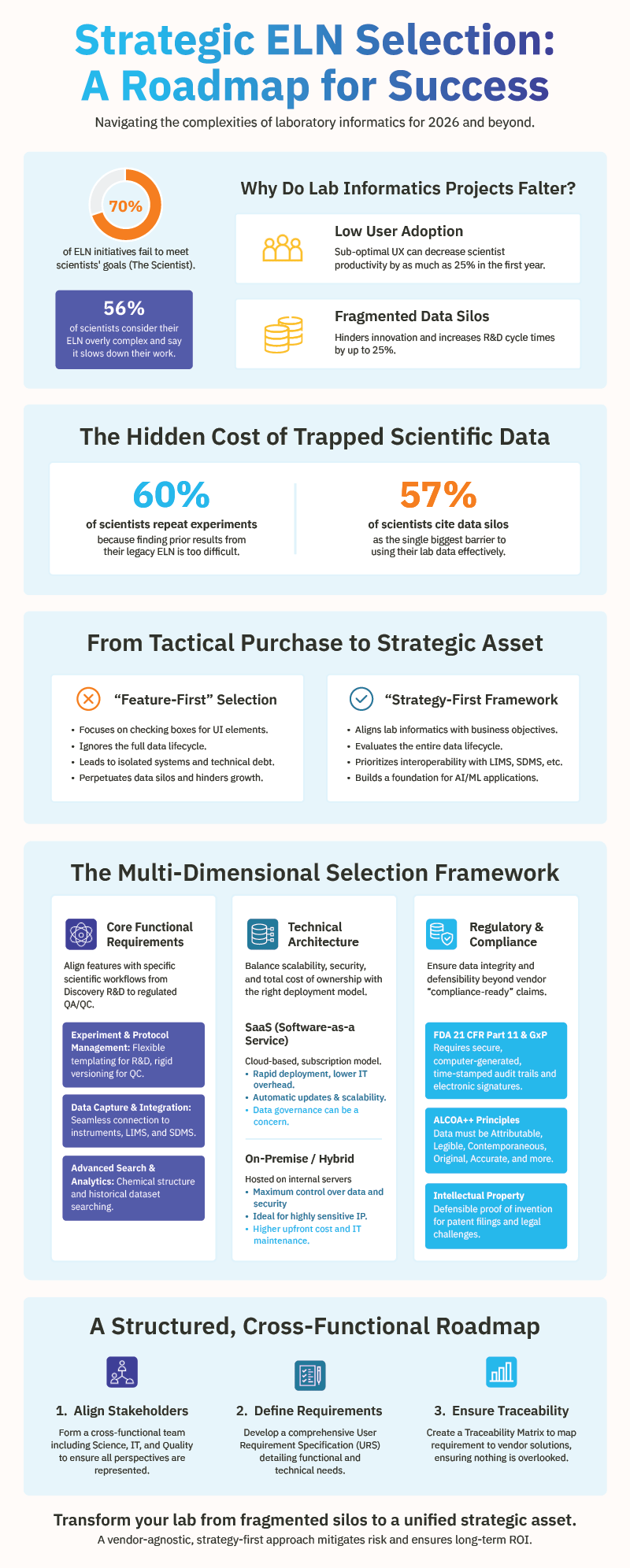
Recent research indicates that 52% of digital transformation initiatives fail to reach their intended goals [1]. In laboratory environments specifically, the picture is even worse: 71% of ELN initiatives fail to realize their users’ objectives, typically because of a disconnect between initial requirements and final deployment to the scientists who use the system [2]. For laboratory leaders wrestling with low user adoption and fragmented data silos, these numbers aren’t abstract – they’re a familiar story. The transition from legacy workflows to a centralized digital environment is a high-stakes endeavor where technical debt and regulatory risk are ever-present. Successfully choosing an ELN (Electronic Laboratory Notebook) system today requires a shift from tactical software acquisition to a strategic alignment of scientific informatics with organizational objectives. Organizations must balance the immediate needs of their bench scientists with the overarching requirements of global data integrity standards and AI-ready data foundations that will shape the next generation of R&D.
This guide provides a vendor-agnostic framework designed to help you master the selection process while ensuring full compliance with FDA 21 CFR Part 11 and GxP guidelines. We’ll explore how to build a defensible selection methodology that prioritizes technical interoperability, functional scalability, and regulatory rigor. By following this structured roadmap, your organization can move beyond the anxieties of audit trails and fragmented systems toward a unified digital strategy that delivers measurable, long-term ROI.
Key Takeaways
- Learn how to transform your laboratory informatics stack from fragmented data silos into a unified strategic asset that accelerates R&D cycle times and secures intellectual property.
- Discover a multi-dimensional framework for choosing an ELN system that balances technical architecture, such as SaaS or hybrid deployments, with core functional requirements like chemical structure searching.
- Understand the critical nuances of FDA 21 CFR Part 11 to ensure your system meets rigorous electronic signature and audit trail standards beyond simple vendor “compliance-ready” claims.
- Follow a structured, cross-functional roadmap to develop a comprehensive User Requirement Specification (URS) and Traceability Matrix that aligns Science, IT, and Quality stakeholders.
- Identify proven strategies to mitigate implementation risks and avoid the common pitfalls that lead to the high failure rates of advanced life sciences technology projects through vendor-agnostic consulting.
Beyond the Digital Page: Why Choosing an ELN System is a Strategic Decision
A modern Electronic Lab Notebook (ELN) functions as the central pillar of a sophisticated scientific and laboratory informatics stack. It’s no longer a mere digital facsimile of a paper notebook; it serves as a comprehensive platform for end-to-end scientific data orchestration. Many life science organizations continue to operate with fragmented data architectures that hinder innovation. Recent research from the Pistoia Alliance suggests that 57% of scientists cite data silos as the single biggest barrier to using their lab data effectively [3]. This lack of visibility increases R&D cycle times because researchers spend excessive hours recreating experiments or hunting for lost results. Choosing an ELN system is a high-stakes strategic decision that dictates how effectively an organization can leverage its own intellectual capital.
Success requires a transition from “feature-first” selection models to “strategy-first” frameworks. Instead of checking boxes for basic UI elements, decision-makers must evaluate how the system supports the entire data lifecycle. This involves assessing interoperability with existing LIMS and SDMS environments. It’s about building a digital roadmap that supports long-term growth. When technology serves as a servant to discovery, the lab becomes a center for high-velocity innovation. Our vendor-agnostic approach emphasizes that the right platform must bridge the gap between bench-level execution and executive-level insight.
The Role of the ELN in Digital Transformation
ELNs act as the primary interface for capturing scientific data at the point of origin. They facilitate the transition from isolated, unstructured observations to searchable, actionable scientific intelligence. Aligning your selection with corporate digital transformation goals ensures that laboratory data integrates into the enterprise-wide analytics engine. This connectivity allows for real-time monitoring of experimental progress; it turns raw data into a strategic asset that informs executive-level decision-making. By standardizing data capture, organizations create a foundation for future AI and machine learning applications.
Protecting Intellectual Property and Data Integrity
The legal and scientific necessity of contemporaneous, timestamped records cannot be overstated. A robust ELN provides the technical controls needed to comply with FDA 21 CFR Part 11 regulations. The system also ensures data follows ALCOA++ principles, making records attributable, legible, and original. During patent filings or regulatory audits, the audit trail provided by a validated ELN acts as the definitive proof of invention. It mitigates the risks of data tampering and ensures the organization’s intellectual property remains defensible in court. Choosing an ELN system with strong data integrity features is the only scalable and realistic way to ensure compliance in an increasingly scrutinized regulatory environment.
The Multi-Dimensional Selection Framework: Functional and Technical Requirements
Selecting the right informatics platform requires a rigorous assessment of how technology serves scientific discovery. When choosing an ELN system, organizations must evaluate functional capabilities through the lens of regulatory compliance and operational efficiency. Core requirements include robust experiment management, precise protocol versioning to satisfy FDA 21 CFR Part 11 standards, and advanced chemical structure searching for discovery teams. A January 2026 industry survey [4] found that 60% of scientists actively repeat experiments because retrieving or finding prior results from their legacy ELN is too difficult. This makes data discoverability and historical search the single most expensive pain point for laboratory leaders, and a primary driver for system replacements.
Technical architecture decisions carry long-term financial and operational consequences. While SaaS deployments offer rapid deployment and reduced IT overhead, some high-security environments still utilize hybrid or on-premise models to maintain absolute control over sensitive intellectual property. This decision impacts scalability, particularly for global organizations managing multi-site data volumes that often exceed petabytes of raw analytical output. Selecting an ELN for your lab involves weighing these infrastructure choices against institutional data security policies and long-term budget constraints.
Scientific Workflow Alignment
The requirements for a Discovery R&D environment differ fundamentally from those in a regulated QA/QC laboratory. Early-stage research demands flexible templating to accommodate evolving experimental designs, whereas QA/QC workflows require rigid, structured data entry to ensure repeatability. Poor user experience (UX) remains a leading cause of adoption failure. Industry reports and peer-reviewed implementation studies consistently note that poorly designed ELN interfaces and poor integration with existing lab systems drive scientists toward manual workarounds during the critical first year of adoption, eroding the productivity gains ELNs are meant to deliver. Achieving a balance between scientific freedom and data integrity is essential for a successful digital transformation strategy.
Technical Interoperability and API Maturity
Modern laboratories operate as interconnected ecosystems. An ELN isn’t an island; it’s a central hub that must communicate with LIMS, SDMS, and diverse analytical instrumentation. Evaluating RESTful APIs and pre-built connectors is vital to ensure seamless data flow. Data portability is equally critical to prevent vendor lock-in. By adopting standardized formats like ADF (Allotrope Data Format), Allotrope Simple Model (ASM), and AnIML (Analytical Information Markup Language), organizations ensure that data remains accessible and readable for decades, regardless of the underlying software’s lifecycle. This commitment to data longevity supports the FAIR (Findable, Accessible, Interoperable, Reusable) principles that drive modern life science innovation.
Navigating Regulatory Compliance and FDA 21 CFR Part 11
Software vendors frequently market their platforms as “compliance-ready,” yet this label is often a strategic trap for the unwary. Technical controls within the software are merely the foundation. The burden of proof for regulatory adherence remains with the laboratory. When choosing an ELN system, organizations must recognize that compliance isn’t a feature; it’s a state achieved through rigorous configuration, procedural controls, and validation. The FDA 21 CFR Part 11 guidelines mandate that electronic records must be as reliable as their paper counterparts. This requires a holistic strategy encompassing system security, data integrity, and human accountability.
Effective implementation supports GxP environments, including GLP, GCP, and GMP. The industry is currently shifting from traditional Computer System Validation (CSV) to Computer Software Assurance (CSA). This risk-based approach, first proposed in the FDA’s 2022 draft guidance and finalized in September 2025 [5], prioritizes testing of high-risk functions over administrative documentation. A 2026 analysis [6] published in the ISRDO journal indicates that a practical, risk-based CSA framework can achieve a 30% to 50% reduction in total validation effort while maintaining or enhancing data quality and rigor. A successful strategy focuses on how the system manages data throughout its lifecycle, ensuring that every scientific observation remains attributable, legible, contemporaneous, original, and accurate.
Audit Trail Integrity and Electronic Signatures
Regulatory audits often uncover red flags like shared user accounts or the ability to modify data without a permanent record. A robust ELN ensures non-repudiation by capturing the “who, what, when, and why” of every entry. Digital “Witnessing” workflows must replicate the rigor of physical signatures. These signatures must be linked to their respective records to prevent unauthorized detachment or reuse. Time-stamping must rely on a secure, central system clock that users cannot alter. Failure to maintain these granular logs can lead to significant regulatory friction, as seen in the 60-80% of FDA Warning Letters that still cite data integrity issues in 2026 [7].
The Validation Lifecycle in ELN Selection
Strategic selection requires incorporating validation requirements directly into the initial RFP. Don’t rely solely on vendor validation packages. These documents prove the software functions in the vendor’s environment, but they don’t validate your specific business processes. Site-specific validation is essential to ensure the system performs as intended under actual laboratory conditions. Choosing an ELN system also means planning for the long term. Maintaining a validated state requires a change control process that evaluates the impact of every software update or patch before deployment to ensure that new features don’t compromise existing data integrity controls.
The Strategic Selection Roadmap: From Stakeholder Alignment to Vendor Audit
The process of choosing an ELN system requires a methodical approach that balances immediate scientific utility with long-term regulatory compliance. Organizations should first establish a cross-functional selection committee comprising stakeholders from R&D, IT, Quality Assurance, and Legal departments. This group ensures the chosen platform supports complex scientific workflows while adhering to FDA 21 CFR Part 11 and EudraLex Annex 11 standards. Without this alignment, firms risk investing in a tool that scientists find cumbersome or that fails to meet the data integrity requirements of a GxP environment.
Developing a Robust URS
A User Requirement Specification (URS) must move beyond generic features to address specific laboratory bottlenecks. Utilizing the MoSCoW methodology allows teams to categorize requirements into Must-have, Should-have, Could-have, and Won’t-have categories. This prioritization ensures that data integrity and audit trail functionality take precedence over non-essential aesthetic preferences. Technical requirements should directly reflect scientific processes; a medicinal chemistry lab might require specific chemical structure indexing that a biologics group doesn’t need. The URS serves as the foundational document for all subsequent validation activities.
Conducting Effective Vendor Demos
Standard vendor presentations often mask technical limitations through curated datasets. To gain an objective view, provide vendors with specific data and scripts that mirror your actual laboratory operations. This “scripted demo” approach forces the software to prove it can handle your specific data volumes and integration needs. During the technical Q&A, watch for red flags such as an inability to provide a clear SOC 2 Type II report or a lack of a defined product roadmap for the next 24 months. Evaluating the vendor’s financial stability is equally vital, as the average ELN lifecycle often spans seven to ten years.
Financial assessment must encompass the Total Cost of Ownership (TCO) rather than just the initial sticker price. When choosing an ELN system, decision-makers must account for the specialized labor required for system configuration and Computer Software Assurance (CSA). Industry benchmarks consistently show that initial license fees represent only a minority share of the total three-year expenditure, with the majority typically allocated to implementation, data migration, and the rigorous validation required by global regulatory bodies.
The final stage involves a formal vendor audit and risk assessment. This audit should scrutinize the vendor’s Quality Management System (QMS) and their internal software development lifecycle (SDLC). A vendor with a high turnover rate in their engineering department or an opaque data exit strategy presents a significant risk to your long-term digital transformation goals. Finalizing the selection requires a traceability matrix that maps every URS requirement to a specific vendor capability, ensuring no functional gaps remain before the contract is signed.
Partner with Astrix for expert guidance in laboratory informatics selection and validation.
Mitigating Implementation Risk with a Vendor-Agnostic Partner
The selection of a platform is only the first hurdle in a digital transformation journey. This brings us back to the staggering statistic highlighted in the opening paragraph of this article: that over 70% of ELN initiatives fail to meet objectives [2]. This gap often stems from a lack of technical oversight during the transition from procurement to configuration. When choosing an ELN system, organizations must account for the intricate interplay between laboratory workflows and 21 CFR Part 11 compliance standards. A vendor-agnostic partner provides the necessary objectivity to evaluate platforms based on functional fit rather than sales incentives. This approach ensures that the chosen technology serves the science, not the other way around.
Bridging the divide between scientific requirements and IT execution requires a deep understanding of both laboratory protocols and data architecture. Many projects stall when IT teams attempt to impose rigid structures on flexible research environments or when scientists don’t fully grasp the constraints of the software. Objective consultants act as a stabilizing force. They translate complex scientific needs into technical specifications that developers can execute. This prevents scope creep and ensures the system maintains data integrity in accordance with FDA regulations and GxP standards from the first day of operation.
The Astrix Approach to ELN Selection
Astrix brings over 30 years of specialized expertise in Scientific & Laboratory Informatics to every engagement. We don’t just facilitate software demonstrations; we develop a comprehensive strategic roadmap that aligns your digital goals with business process optimization. Our team analyzes your current state to identify bottlenecks that a new system might inadvertently replicate. By focusing on Laboratory Informatics Services, we ensure your technical architecture is robust, scalable, and fully compliant with global regulatory expectations. We’ve managed hundreds of implementations, giving us the foresight to anticipate challenges before they disrupt your timeline.
Maximizing Long-Term ROI
Long-term ROI depends on what happens after the initial “Go-Live” date. High user adoption remains the primary indicator of success. Scientific staff often resist new tools if they perceive them as burdensome or non-compliant with rigorous data standards. Astrix mitigates this risk through scientist-led training programs and managed services that address “Day 2” optimization needs. By focusing on time-to-value, we help laboratories reduce the typical 18-to-24-month implementation cycle by up to 30% through proven methodologies. Our goal is to ensure your investment continues to yield dividends as your research scales.
Ready to secure your digital future? Partner with Astrix for a Strategic ELN Selection Roadmap to ensure your technology investment delivers measurable scientific and operational results.
Advancing Scientific Discovery Through Strategic Informatics Selection
Selecting the right digital foundation isn’t merely a technical upgrade; it’s a fundamental shift in how your organization maintains data integrity and accelerates research. When choosing an ELN system, decision-makers must prioritize a multi-dimensional framework that aligns functional requirements with strict regulatory mandates like FDA 21 CFR Part 11. Gartner predicts that through 2026, organizations will abandon 60% of AI initiatives that are not supported by AI-ready, interoperable data [8], underscoring why eliminating data silos is foundational to R&D efficiency. Astrix leverages over 30 years of laboratory informatics expertise to guide organizations through this complex landscape. Our vendor-agnostic approach ensures your selection remains objective and focused on long-term scalability. By centering your strategy on GxP compliance and stakeholder alignment, you’re not just buying a tool; you’re securing the future of your scientific output. Speak with one of our expert ELN consultants today. We’re here to help you transform your laboratory into a model of digital efficiency and scientific excellence.
Frequently Asked Questions
What is the primary difference between an ELN and a LIMS for choosing a system?
ELNs prioritize the management of unstructured experimental data and intellectual property, while LIMS focus on structured, sample-centric workflows and repeatable laboratory processes. The process of choosing an ELN system requires a clear distinction between these two informatics pillars. ELNs provide the flexibility needed for hypothesis-driven research, whereas LIMS maintain the rigid control required for high-throughput testing and quality assurance environments.
Is a cloud-based ELN secure enough for highly regulated pharmaceutical R&D?
Modern cloud-based ELNs provide security protocols that frequently exceed the capabilities of on-premise installations, provided they adhere to SOC 2 Type II and ISO 27001 standards. Cloud-based deployment has become the industry norm for new informatics implementations in pharmaceutical sectors. These platforms utilize advanced encryption and multi-factor authentication to protect sensitive data while ensuring high availability for global research teams.
How much does a typical ELN system implementation cost for a mid-sized lab?
Total implementation costs are generally calculated as a ratio of the software license fee rather than a fixed sum. Industry benchmarks suggest that organizations should budget between 50% and 150% of the initial software cost for professional services, including configuration, data migration, and formal validation [9]. It’s essential to evaluate the total cost of ownership over a five-year period to account for recurring maintenance and infrastructure support.
Does an ELN automatically make my lab 21 CFR Part 11 compliant?
An ELN doesn’t automatically grant compliance; it provides the technical controls necessary for an organization to meet FDA 21 CFR Part 11 requirements. You’re responsible for establishing the procedural controls, such as Standard Operating Procedures and personnel training, that complement the software’s electronic signatures and audit trails. The FDA’s 2003 guidance on Part 11 emphasizes that validation must be specific to the system’s intended use in your environment.
How long does the ELN selection and implementation process usually take?
The comprehensive lifecycle for choosing an ELN system and completing its deployment typically spans 9 to 15 months for a mid-sized organization. The initial selection phase generally requires 3 to 4 months to align stakeholders and evaluate vendors. Following this, the configuration, pilot testing, and regulatory validation phases consume the remaining 6 to 11 months, ensuring the system is technically sound and ready for full-scale production.
Can an ELN integrate with my existing chromatography data system (CDS)?
ELNs integrate with Chromatography Data Systems through specialized APIs or vendor-neutral data formats such as AnIML and SiLA. This digital connectivity eliminates manual data transcription, a known source of data entry errors that peer-reviewed studies of manual laboratory environments have measured at rates ranging from under 1% to as high as 5% per workflow [10]. By establishing a direct digital thread between your CDS and ELN, you ensure that raw data and processed results remain synchronized, traceable, and searchable.
What are the most common reasons scientists resist ELN adoption?
Scientists often resist ELN adoption because of perceived workflow disruptions and the increased time required for structured data entry compared to paper. A January 2026 survey of scientists across biopharma R&D, CROs, clinical diagnostics, and pharmaceutical manufacturing found that 56% consider their ELN overly complex and say it slows down their work [3]. Successful adoption requires a strategic change management plan that demonstrates immediate value, such as automated report generation or the ability to search historical experiments in seconds.
Should we choose a discipline-specific ELN or an enterprise-wide platform?
The decision depends on the balance between specialized functional depth and the need for organizational data harmony across the 2026 digital landscape. Discipline-specific tools offer granular features for chemistry or biology, but they often create data silos that hinder cross-departmental collaboration. Enterprise platforms provide a unified data architecture, which reduces the long-term cost of system maintenance and simplifies the global digital transformation roadmap for the entire organization.
About Astrix
Astrix is the global leader in delivering innovative strategies and solutions to the life sciences industry. Powered by world-class people, proven processes, and advanced technology, Astrix partners with clients to drive measurable improvements in business performance, scientific advancement, and clinical outcomes—ultimately driving towards a goal of improving quality of life. Founded by scientists to address the industry’s most complex challenges, Astrix provides a growing portfolio of strategic and technical services that deliver immediate impact while enabling long-term digital transformation. Our deep expertise spans strategic planning, data strategy, AI/ML readiness and technologies, lab informatics, and modern clinical operations and eClinical platforms so we can successfully deliver solutions that have high impact and drive better outcomes for everyone.
References
[1] Gartner. “2026 CIO and Technology Executive Survey.” November 25, 2025. https://www.gartner.com/en/documents/7374630
[2] The Scientist. ” Electronic Lab Notebooks Are Failing Researchers. Could AI Tools Help?” January 30, 2026. https://www.the-scientist.com/electronic-lab-notebooks-are-failing-researchers-could-ai-tools-help-74024
[3] Pistoia Alliance. ” Annual Lab of the Future Survey.” September 25, 2025. https://pistoiaalliance.org/news/survey-ai-adoption-life-sciences-labs-skills-gap/
[4] Sapio Sciences. “Research Finds Scientists View ELNs as ‘Glorified Filing Cabinets,’ Driving Frustration, Duplication and Shadow AI Use.” January 27, 2026. https://www.sapiosciences.com/news/research-finds-scientists-view-elns-as-glorified-filing-cabinets-driving-frustration-duplication-and-shadow-ai-use/
[5] U.S. Food and Drug Administration. “Computer Software Assurance for Production and Quality System Software” (final guidance). Federal Register, September 24, 2025. https://www.federalregister.gov/documents/2025/09/24/2025-18468/computer-software-assurance-for-production-and-quality-system-software-guidance-for-industry-and
[6] Patel, B. & Patel, J. “Integrating Computer Software Assurance into Existing Computer System Validation Programs: A Practical Risk-Based Framework.” ISRDO Journal (SRJSET), 2026. https://isrdo.org/journal/SRJSET/currentissue/integrating-computer-software-assurance-into-existing-computer-system-validation-programs-a-practical-risk-based-framework
[7] Fatima, Mussarat. “Why 60–80% of FDA Warning Letters Still Cite Data Integrity in 2026.” MF License & Regulatory Consultants (MFLRC), June 2026. https://mflrc.com/article/fda-data-integrity-warning-letters-2026
[8] Gartner. “Lack of AI-Ready Data Puts AI Projects at Risk.” February 26, 2025. https://www.gartner.com/en/newsroom/press-releases/2025-02-26-lack-of-ai-ready-data-puts-ai-projects-at-risk
[9] LabSoftwareGuide. “How to choose an ELN” January 2026. https://labsoftwareguide.com/eln-software/
[10] Mays, J.A. & Mathias, P.C. “Measuring the Rate of Manual Transcription Error in Outpatient Point-of-Care Testing.” Journal of the American Medical Informatics Association, 2019;26(3):269-272. https://academic.oup.com/jamia/article/26/3/269/5287977