

In this blog, we explore the full stack of clinical research technology in 2026. Clinical trial delays carry substantial financial consequences: a Tufts CSDD analysis associated a single day of delay with approximately $800,000 in unrealized prescription drug or biologic sales (Smith, DiMasi, & Getz, 2024) [1]. It’s essential to navigate the complexities of various disparate solutions and platform integrations, ensuring a comprehensive understanding of how these implementations will align with current operations and what processes need to adapt accordingly.
This guide provides a strategic framework for moving from siloed clinical operations to a unified, interoperable digital ecosystem. For 2026, the argument is no longer “paper to digital.” The inflection point is the convergence of ICH E6(R3), risk-proportionate quality expectations, CSA-style validation thinking, decentralized trial normalization, and stronger scrutiny of computerized systems and electronic records across FDA- and EMA-regulated environments.
Key Takeaways
- Evaluate the strategic transition from legacy manual processes to real-time, decentralized trial models to optimize operational efficiency and data accuracy.
- Identify the core components of a high-performing informatics stack, focusing on integrating Electronic Data Capture (EDC) and Clinical Trial Management Systems (CTMS).
- Ensure absolute regulatory compliance by aligning your clinical research technology selection with FDA 21 CFR Part 11 and comprehensive GxP requirements.
- Establish a future-ready digital framework by prioritizing system interoperability through standardized data formats and robust API integration.
- Develop a scalable roadmap for incorporating artificial intelligence and machine learning while maintaining rigorous data governance across the clinical lifecycle.
Why 2026 Is an Inflection Point for Clinical Research Technology
Clinical research technology now sits at the center of trial quality, evidence generation, and inspection-readiness. The most important 2026 shift is regulatory and operational: ICH E6(R3) reframes Good Clinical Practice around flexibility, quality by design, risk-based quality management, participant protection, and reliable trial results. That makes technology architecture a quality decision, not just an operational one.
Three changes define the 2026 agenda.
- The shift from “essential documents” to “essential records” raises expectations for traceability across source data, metadata, audit trails, and trial oversight.
- Quality activities must be proportionate to risk, with critical-to-quality factors driving monitoring, validation, and governance decisions.
- The industry’s movement from documentation-heavy Computer System Validation toward Computer Software Assurance encourages teams to focus testing evidence on the functions that matter most to participant safety, product quality, and data integrity.
Decentralized and Hybrid Trials Are Now Normal Operating Models
Decentralized and hybrid trial elements have moved from pandemic-era contingency planning to standard protocol design. Telemedicine, eConsent, Electronic Clinical Outcomes Assessments (eCOA), wearables, remote source data, and home health interactions expand the clinical data perimeter. That expansion increases the need for validated systems, clear data lineage, role-based access, secure audit trails, and governance that can withstand inspection across sponsors, CROs, sites, laboratories, and technology vendors.
Legacy Systems vs. Modern Informatics Platforms
Fragmented legacy systems create data silos, reconciliation burden, inconsistent access controls, and avoidable inspection risk. Modern clinical research technology favors cloud-based, interoperable platforms that connect EDC, CTMS, Electronic Trial Master File (eTMF), and Interactive Response Technology (IRT), laboratory systems, electronic health records, and analytics environments. The goal is a governed data flow that preserves context from capture through submission while giving trial teams timely visibility into enrollment, safety signals, document completeness, supply status, and quality risks.
The Four Pillars of a High-Performing Clinical Research Technology Stack:
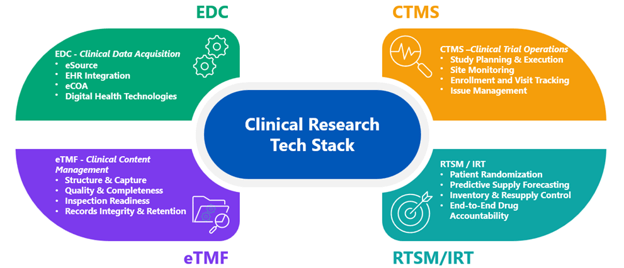
A successful trial technology architecture depends on four foundational pillars: EDC, CTMS, eTMF, and IRT. Each pillar has a distinct job, a clear 2026 shift, and a critical integration point. Treating them as equal parts of one ecosystem prevents the common failure mode of optimizing one platform while leaving the rest of the trial operating model fragmented.
Electronic Data Capture: Unified Clinical Data Acquisition
EDC remains the primary environment for collecting, cleaning, and managing protocol-defined clinical data. The 2026 shift is that EDC can no longer be treated as a standalone database; it must receive and reconcile data from eSource, eCOA, Electronic Health Records (EHR) integrations, laboratory systems, and digital health technology (DHT) while preserving provenance and auditability. The integration point is data standardization: EDC should support controlled terminology, CDISC-aligned structures, and secure interfaces that allow clinical, safety, biomarker, and operational data to move without manual re-entry.
Pro tip: Participant-facing data capture technologies like eCOA and DHT require regulatory and IRB/Ethics review, local translations, and linguistic validation. Choosing the technology is the first step, followed by active implementation management to ensure these solutions are not a rate-limiter for targeted study start dates.
Clinical Trial Management System (CTMS): Operational Command Center
A CTMS provides oversight of study startup, site activation, enrollment, monitoring, milestones, budgets, and investigator relationships. The 2026 shift is from retrospective tracking to predictive operational control: teams need earlier visibility into site performance, recruitment risk, monitoring burden, and quality signals. The integration point is shared operational truth. CTMS data should connect with EDC, eTMF, IRT, and finance workflows, so study leaders can see whether patient activity, document completeness, supply readiness, monitoring status, and payments are aligned.
Pro tip: Trial management technologies are evolving quickly as issue management and data quality oversight are increasingly centralized in dashboards and automated/guided mitigation strategies aligned with established quality tolerance limits and operating procedures.
Electronic Trial Master File (eTMF): Essential Records and Inspection Readiness
An eTMF is the governed repository for the essential records that demonstrate trial conduct, oversight, and compliance. The 2026 shift is broader than digitizing documents: ICH E6(R3) puts greater emphasis on records that are complete, reliable, accessible, and proportionate to the risks of the trial. The integration point is event-driven completeness. eTMF workflows should connect to CTMS milestones, site activation status, monitoring outcomes, protocol amendments, and vendor oversight so missing or late records are visible before inspection preparation begins.
Interactive Response Technology (IRT): Randomization and Clinical Supply Control
IRT manages randomization, treatment assignment, blinding, dispensing, resupply, returns, and temperature-sensitive supply logistics. The 2026 shift is rising protocol complexity: adaptive designs, global enrollment variability, decentralized visits, and specialty therapies place more pressure on real-time supply decisions. The integration point is synchronized status. IRT should exchange data with EDC, CTMS, eTMF, and supply-chain systems, so that patient eligibility, drug availability, kit assignment, protocol deviations, and inventory risk are visible together.
Interoperability as the Connective Tissue
Interoperability is what turns individual systems into a clinical research ecosystem. Sponsors should prioritize platforms that support standard data models, secure APIs, controlled terminology, role-based permissions, audit trails, and scalable integration patterns. The objective is not to connect with everything for its own sake; it is to preserve a single, trusted chain of evidence from patient interaction through analysis, submission, and inspection.
Compliance as the Constraint: Part 11, Annex 11, ALCOA+, and CSA
Regulatory compliance is the design constraint that determines whether a clinical research technology stack can scale. Systems must support electronic records and signatures, audit trails, security controls, data integrity, validation evidence, and clear accountability across sponsors, CROs, sites, laboratories, and vendors. For global programs, FDA 21 CFR Part 11, EU Annex 11 principles, EMA expectations for computerized systems in clinical trials, ALCOA+ data integrity, and risk-based CSA practices should be considered together rather than as separate checklists.
FDA 21 CFR Part 11 and Computer System Validation (CSV)
21 CFR Part 11 establishes expectations for trustworthy electronic records and electronic signatures, including validation, audit trails, access controls, and record retention. CSA adds a practical operating model: validation effort should be proportionate to intended use and risk, with the strongest evidence focused on functions that can affect participant safety, product quality, or data integrity. This approach can reduce low-value documentation while strengthening the evidence regulators need to see.
Implementing ALCOA+ Principles for Scientific Data Integrity
ALCOA+ principles require clinical data and metadata to be attributable, legible, contemporaneous, original, accurate, complete, consistent, enduring, and available. In practice, that means systems must capture who did what, when, why, and from which source; preserve the original record; control changes through secure audit trails; and make critical evidence retrievable throughout the data lifecycle. EMA guidance on computerized systems and electronic data reinforces the same themes for clinical trials, including validation, user management, security, electronic signatures, eCOA, IRT, audit trails, and risk-based oversight.
AI and Machine Learning as the Frontier
AI and machine learning can help clinical organizations improve protocol design, site feasibility, patient identification, risk-based monitoring, data review, safety signal detection, and medical writing workflows. The opportunity is real, but so is the governance burden. Models used in regulated contexts require transparent intended use, data-quality controls, documented human oversight, bias and performance monitoring, access controls, and change management that keep automation aligned with participant protection and reliable trial results.
Architecting a Resilient Digital Foundation: Four Practical Steps
- Assess the current state ecosystem. Begin by mapping the systems, workflows, data sources, ownership models, and pain points across clinical operations, regulatory affairs, quality, and data management. This assessment should identify where manual reconciliation, duplicate entry, inconsistent metadata, limited visibility, or weak governance create operational drag or inspection risk.
- Define the target architecture. Use the four strategic pillars as the foundation, then define the integration requirements, data standards, access controls, and essential-records governance needed to support the full trial lifecycle. The target state should make clear how information moves between systems, who owns each data domain, and how traceability will be maintained from capture through inspection.
- Apply risk-proportionate compliance controls. Translate regulatory expectations into practical controls for Part 11, EU Annex 11, ALCOA+, and Computer Software Assurance. Rather than treating compliance as a documentation exercise, focus validation evidence and oversight on the functions that carry the greatest risk to participant safety, product quality, data integrity, and trial continuity.
- Sequence implementation through a phased roadmap. Prioritize the capabilities that produce the greatest near-term value while reducing risk. A practical roadmap should balance inspection-readiness, user adoption, interoperability, and measurable operational outcomes, with each phase building toward a more connected and resilient clinical research ecosystem.
Astrix brings vendor-agnostic clinical and laboratory informatics expertise to help life science organizations translate that roadmap into a governed, scalable operating model. We center on user requirements throughout the process, supporting selection and informing strategic implementation, along with a deep bench skilled in data integrations, computer system validation, and overall project management centered on standing up the technology in line with planned clinical development milestones and trials.
Partner with Astrix for Expert Clinical Research Technology Consulting
About Astrix
Astrix is the global leader in delivering innovative strategies and solutions to the life sciences industry. Powered by world-class people, proven processes, and advanced technology, Astrix partners with clients to drive measurable improvements in business performance, scientific advancement, and clinical outcomes – ultimately driving towards a goal of improving quality of life. Founded by scientists to address industry’s most complex challenges, Astrix provides a growing portfolio of strategic and technical services that deliver immediate impact while enabling long-term digital transformation. Our deep expertise spans strategic planning, data strategy, AI/ML readiness and technologies, lab informatics, and modern clinical operations and eClinical platforms, so we can deliver high-impact solutions that drive better outcomes for everyone.
Frequently Asked Questions:
What are the most critical components of a clinical research technology stack?
A high-performance stack includes EDC, CTMS, eTMF, and IRT, supported by integration, analytics, identity management, audit trails, and data governance. The strongest architectures do not evaluate these systems independently; they define how patient data, operational milestones, essential records, and clinical supply status move together across the trial lifecycle.
How does FDA 21 CFR Part 11 impact clinical research software?
FDA 21 CFR Part 11 affects clinical research software by setting expectations for trustworthy electronic records and electronic signatures. Systems must support validated performance, secure access, audit trails, electronic signature controls, and records that can be retained and retrieved for inspection.
What is the difference between EDC and CTMS in clinical trials?
EDC manages protocol-defined clinical data, including case report forms, queries, edit checks, and data cleaning. CTMS manages trial operations, including sites, milestones, monitoring activity, enrollment status, budgets, and investigator relationships. Integration between the two reduces duplicate work and gives study leaders a more complete view of trial health.
How can technology improve patient recruitment and retention in clinical research?
Technology can improve recruitment and retention by reducing participant burden, expanding access beyond traditional sites, enabling remote consent and assessments, and giving study teams earlier visibility into enrollment bottlenecks. Digital tools are most effective when they are designed around participant experience, protocol fit, data quality, and privacy from the start.
What is the role of an eTMF in ensuring regulatory compliance?
An eTMF provides the governed repository for essential records that demonstrate trial conduct, oversight, and compliance. In 2026, eTMF value depends on more than storage: sponsors need metadata strategy, document governance, role-based workflows, quality checks, inspection-readiness dashboards, and alignment with ICH E6(R3), GCP, Part 11, and ALCOA+ expectations.
How is AI currently being used to optimize clinical research outcomes?
AI is being used to support feasibility analysis, patient identification, site selection, risk-based monitoring, data review, safety surveillance, and drafting workflows. In regulated environments, these tools require documented intended use, fit-for-purpose (GCP) validation, human oversight, model performance monitoring, and governance that protects data integrity and participant safety. This powerful tool requires considered deployment, given the process change involved for users shifting to AI-powered tools designed to aid their day-to-day work.
Reference:
[1] Smith, Z., DiMasi, J., & Getz, K. (2024). Quantifying the value of a day of delay in drug development (White paper). Tufts Center for the Study of Drug Development. https://csdd.tufts.edu/sites/default/files/2025-02/Aug2024%20Day%20of%20Delay%20White%20Paper%20Final.pdf [csdd.tufts.edu]