

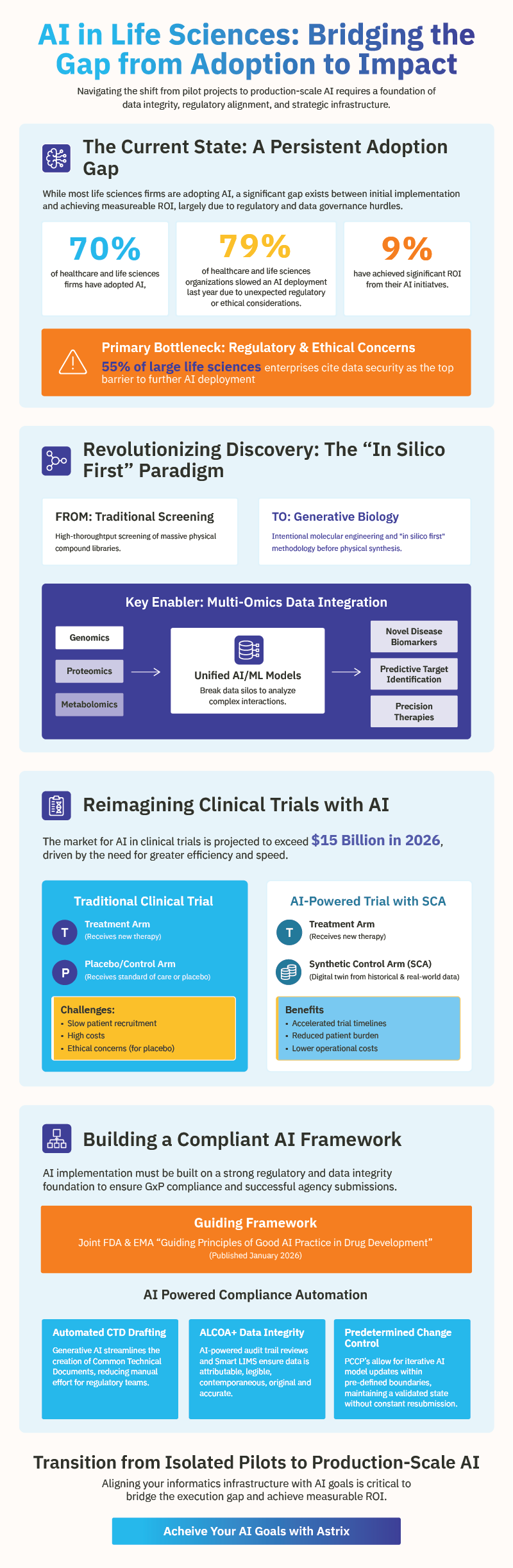
AI adoption across healthcare and life sciences organizations has risen to 70%, up from 63% the year before [1], but many of these organizations have not yet successfully integrated generative AI models into core decision support systems. This adoption gap persists in part because a clear majority of large life sciences enterprises cite data security, along with legacy system integration challenges, skills gaps, costs and compliance concerns, as their top barrier to further AI deployment [2]. Identifying the top five ways AI will reshape life sciences in the next twelve months requires moving past the initial hype toward a foundation of data integrity and infrastructure modernization.
In this article we provide a roadmap for aligning your informatics infrastructure with the joint FDA and EMA Guiding Principles of Good AI Practice in Drug Development published in January 2026. This analysis moves from broad industry challenges to structured, multi-phase solutions to ensure your organization transitions from isolated pilot projects to production-scale AI that yields tangible results.
Key Takeaways
- Evaluate how generative biology and multi-omics data integration are advancing de novo protein design and predictive target identification.
- Discover how agentic systems and synthetic digital twins are shortening clinical trial durations and complexity while reducing the need for traditional placebo arms.
- Explore how AI is modernizing clinical development and regulatory operations by enabling faster decision-making, stronger compliance, and improved safety monitoring.
- Assess the evolution of laboratory informatics toward Smart LIMS environments that utilize automated capture and ALCOA+ principles to maintain real-time data integrity.
- Understand why it’s critical to align informatics infrastructure with AI goals to achieve measurable ROI while addressing the specialized skills gap.
Trend 1 – Accelerating Early-Stage Discovery: Generative Biology and Predictive Modeling
The paradigm of drug discovery has been shifting from traditional high-throughput screening to a generative, “in silico first” methodology. Strategic investment, such as the $1 billion NVIDIA and Eli Lilly co-innovation lab established in January 2026, underscores the industry’s commitment to high-throughput virtual screening of massive chemical libraries to identify viable leads before any physical synthesis occurs.
This transition is anchored by the availability of sophisticated tools like AlphaFold 3, which provides critical insights into protein-ligand interactions, and AlphaProteo for the design of novel protein binders. As organizations evaluate the top five ways AI will reshape life sciences in the next twelve months, the shift toward generative protein design stands out as a primary driver of efficiency. These advancements allow researchers to move beyond descriptive biology into the realm of intentional molecular engineering, where lead generation and multi-objective lead optimization occur simultaneously.
While the potential for cost reduction is substantial, current data indicates a significant execution gap. Although AI adoption in healthcare and life sciences has reached roughly 70% [1], only 9% of life sciences leaders report achieving a significant ROI from these investments as of 2026 [3]. This discrepancy highlights the necessity of expert artificial intelligence life sciences consulting to bridge the divide between pilot projects and production-scale discovery.
From Hits to Leads: Generative Chemistry in 2026
Modern discovery workflows can now utilize AI to predict ADME/Tox properties with high precision, significantly filtering the candidate pool before laboratory validation. Biotechnology companies of all sizes are increasingly adopting AI-driven predictive modeling to accelerate hit prioritization and optimize lead selection, often integrating these capabilities with existing cheminformatics platforms. It’s no longer sufficient to identify a hit; the model must simultaneously optimize safety and manufacturability. This holistic approach ensures that the “In Silico First” model isn’t just a trend but a fundamental shift in how we approach de novo molecular design and lead refinement.
Multi-Omics Integration for Precision Medicine
Breaking the historical data silos between genomics, proteomics, and metabolomics is essential for the next generation of precision therapies. AI identifies novel disease biomarkers by analyzing complex interactions across these disparate datasets, enabling the identification of specific patient sub-populations for rare diseases. Meaningful AIML consulting for life sciences focuses on creating the unified data architecture necessary for these models to function. By aligning fragmented data into a cohesive framework, organizations can leverage predictive modeling to anticipate clinical outcomes within these targeted cohorts long before the first patient is enrolled.
Trend 2 – Transforming Clinical Development: from Reactive to Predictive
The global market for AI in clinical trials is projected to exceed $13 billion in 2026 and is on track to reach nearly $55 billion by 2030 [4], reflecting a massive shift toward data-driven execution. This growth is fueled by the industry’s need to solve chronic recruitment delays and rising costs associated with quality oversight.
When examining the top five ways AI will reshape life sciences in the next twelve months, the optimization of patient recruitment and site selection emerges as a critical operational priority. By analyzing real-world data and electronic health records, AI identifies high-potential sites and eligible patient cohorts with unprecedented speed, giving sponsors confidence that the target patient population meets the eligibility criteria for their clinical trial.
The Rise of Synthetic Control Arms and In Silico Trials
Synthetic Control Arms (SCAs) represent a significant accelerator in clinical development, particularly beneficial in oncology and rare diseases, where traditional placebo groups can be challenging to obtain. These digital twins leverage historical clinical data sets and real-world evidence to meet rigorous regulatory requirements while reducing the total number of patients required. The joint FDA and EMA “Guiding Principles of Good AI Practice in Drug Development,” published in January 2026 [5], provides the necessary framework for these advancements. These principles emphasize risk-based validation and transparency, allowing sponsors to deploy SCAs with greater confidence in their regulatory acceptance. This shift reduces the ethical burden on patients while accelerating the delivery of life-saving therapies.
Continuous Trial Monitoring and Adaptive Optimization
Beyond trial design, AI is reshaping how sponsors monitor safety and efficacy, providing a pathway to comprehensive data quality oversight. Real-time analysis of wearable device data, electronic health records, and lab results allows clinical teams to detect adverse events and protocol deviations far earlier than periodic manual review would allow, shifting safety monitoring from a retrospective audit to a continuous, predictive discipline. Adaptive trial designs, informed by these real-time data streams, let sponsors adjust dosing, enrollment criteria, or endpoints mid-study without compromising statistical integrity, reducing the number of patients exposed to ineffective treatments.
This same predictive lens is being applied to trial operations themselves: machine learning models now forecast enrollment timelines and site performance, flagging underperforming sites before they jeopardize a study’s overall timeline [6]. The ability of AI to organize the array of trial data sources, operational plans, and protocol requirements facilitates a centralized “command center” approach to trial oversight. This method enables targeted on-site monitoring and proactive issue resolution. As a result, it can lower the overall costs of on-site monitoring, allowing research sites to concentrate more on participant enrollment and care rather than hosting on-site monitoring visits. As these capabilities mature, sponsors are increasingly able to treat clinical development as a continuously optimized process rather than a fixed protocol executed in stages, further reinforcing the shift from reactive to predictive development that defines this trend.
Trend 3 – Optimizing Regulatory and Pharmacovigilance Operations
Artificial intelligence is transforming regulatory, safety, and compliance operations from periodic, document-driven activities into continuously monitored, intelligence-driven processes. By automating regulatory authoring, strengthening GxP compliance, enhancing pharmacovigilance, and providing real-time regulatory intelligence, AI enables life sciences organizations to improve operational efficiency, maintain inspection readiness, and respond more rapidly to evolving global regulatory requirements throughout the product lifecycle.
Automating Regulatory Authoring and GxP Validation
Generative AI is now being deployed to automate the drafting of Common Technical Documents (CTD), significantly reducing the manual burden on regulatory teams [7]. Beyond document generation, AI-powered audit trail reviews are becoming standard for ensuring data integrity under ALCOA+ principles. A vital component of this new landscape is the implementation of Predetermined Change Control Plans (PCCPs). These plans allow for iterative AI model updates without the need for constant new submissions, provided the changes remain within pre-defined boundaries. For organizations struggling to maintain a validated state during rapid technological shifts, engaging specialized regulatory and compliance services is a prudent step toward long-term operational stability. This approach ensures that your AI-driven systems remain compliant with the FDA’s latest action plans for AI/ML-based software while maintaining rigorous GxP standards.
Continuous Safety Surveillance and Regulatory Intelligence
Pharmacovigilance is another area being reshaped by automation. AI-powered natural language processing (NLP) can now triage adverse event reports and scan scientific literature and social media for emerging safety signals, allowing pharmacovigilance teams to focus their expertise on serious or ambiguous cases rather than routine case intake and coding [8]. The ability to summarize and generate narratives for safety signals streamlines the preparation of summary content for clinical study reports and other structured safety content.
Regulatory intelligence tools are also being deployed to continuously monitor evolving requirements across the FDA, EMA, and other global authorities, flagging changes that could affect submission strategy or labeling before they become compliance gaps. Together with automated audit trail review, these tools are shifting regulatory affairs from a periodic, submission-driven function into a continuously monitored one. Organizations that pair these capabilities with strong change control discipline, including well-documented PCCPs, are best positioned to keep pace with an increasingly dynamic global regulatory environment without sacrificing the audit-readiness that GxP-regulated operations demand.
Trend 4 – The Intelligent Laboratory: Reshaping Informatics Infrastructure
The shift toward the “Smart LIMS” represents a fundamental evolution in how data serves the enterprise. 98% of healthcare and life sciences organizations now plan to modernize their infrastructure for AI workloads as of August 2025 [9]. This isn’t just about storage. It’s about shifting from passive data collection to active data readiness. Among the top five ways AI will reshape life sciences in the next twelve months, the integration of real-time data integrity monitoring stands out. By embedding ALCOA+ principles directly into the informatics layer, companies can ensure that model training is based on high-fidelity, validated data.
Predictive maintenance for laboratory instrumentation is another critical advancement. By creating digital twins of complex hardware, laboratories can anticipate failures before they occur. This proactive stance is essential for maintaining the continuous operation required in high-throughput environments. It protects critical sample integrity and minimizes expensive downtime.
Building an AI-Ready Data Foundation
A robust AI strategy is impossible without a standardized data foundation. Organizations are increasingly adopting formats like ADF (Allotrope Data Format) and AnIML (Analytical Information Markup Language) to ensure interoperability across disparate systems. A Laboratory Information Management System (LIMS) acts as the central backbone, orchestrating the flow of information from the bench to the cloud. Where companies currently report no tangible benefits from generative AI, the gap is largely attributed to the fact that the majority of project failures stem from poor data engineering and the inability to process non-standardized datasets. Without this foundational rigor, even the most sophisticated models will fail to deliver actionable insights. If you’re looking to modernize your architecture, laboratory informatics services provide the strategic oversight needed to align your systems with AI goals.
Autonomous Labs and Robotics Integration
The trend toward “lights-out” laboratories is accelerating, where AI-driven systems manage complex, multi-step processes with minimal human intervention [10]. This closes the loop between hypothesis generation and robotic execution. It allows for 24/7 experimentation without the need for constant supervision. Real-time optimization of workflows through machine learning ensures that resources are allocated efficiently, reducing bottlenecks in sample processing. Technologies like voice-activated ELNs and Smart Glass are further streamlining data capture. They ensure that every observation is recorded at the point of origin without disrupting the scientist’s focus. This level of automation is no longer a futuristic concept. It’s an operational requirement for remaining competitive.
Trend 5 – The Human Element: Strategic Staffing and AI Governance
Success in digital transformation relies as much on human capital as it does on algorithmic sophistication. The final entry in our analysis of the top five ways AI will reshape life sciences in the next twelve months is the emergence of specialized ‘Scientific AI’ roles. These hybrid professionals possess the rare ability to bridge the gap between complex biological contexts and advanced data science. Organizations must prioritize the identification and development of these bilingual experts to move beyond isolated pilot projects and achieve a measurable ROI.
Bridging the Specialized Scientific Talent Gap
The demand for expertise that combines domain specific scientific knowledge with machine learning proficiency has never been higher. Rapid implementation often requires immediate access to these high-level skill sets. While many organizations look toward internal reskilling, external expertise is frequently necessary to maintain momentum and ensure data integrity. Accessing specialized resources allows organizations to identify the talent required for high-stakes technical environments. This strategic approach to team composition ensures that your informatics infrastructure is managed by those who understand both the regulatory constraints and the technical possibilities of modern AI.
AI Governance and the Future of Work
A significant hurdle to AI adoption is the ‘black box’ skepticism prevalent among principal investigators and senior scientists. This uncertainty contributes to the fact that 37% of life sciences enterprises cite skills gaps as a leading barrier to AI deployment [2]. Overcoming this requires a robust Ethical AI Governance Framework that emphasizes transparency and risk-based validation, as outlined in the January 2026 joint FDA and EMA guiding principles. A robust governance framework should include:
- Formalized, cross-functional oversight committees
- Risk-based validation protocols for all AI-driven systems
- Standardized data governance and transparency measures
In the twelve-month outlook, organizations must prioritize investments that align informatics infrastructure with these regulatory expectations. Success isn’t found in a single tool but in a holistic strategy that integrates people, processes, and technology. Platform-neutral consulting is critical for navigating this landscape, as it provides objective oversight without the bias of proprietary software interests. To ensure your laboratory is prepared for this shift, partner with Astrix for your AI-driven digital transformation and secure a steady hand in an intricate regulatory landscape.
Securing a Competitive Advantage in the AI-Enabled Life Sciences Era
The transition from experimental AI pilots to production-scale operations requires a meticulous alignment of informatics infrastructure, regulatory compliance, and specialized human expertise. We’ve established that the top five ways AI will reshape life sciences in the next twelve months center on moving beyond the hype toward foundational data readiness and risk-based validation. Organizations that successfully integrate ‘Smart LIMS’ while adhering to the joint FDA and EMA guiding principles will secure a significant competitive advantage.
Astrix provides over 30 years of lab informatics expertise to guide these complex digital transformations, offering a steady hand across our global footprint in the US, Europe, and Costa Rica. Our focus on specialized technical resources for GxP-regulated environments ensures that technical managers and executive leadership maintain absolute data integrity throughout the model lifecycle. By prioritizing platform-neutral advice and comprehensive strategic planning, you’ll transform these technological advancements into tangible discovery outcomes. The path forward is complex, but with the right strategic partner, your organization is well-positioned to lead the next era of scientific innovation.
About Astrix
Astrix is the global leader in delivering innovative strategies and solutions to the life sciences industry. Powered by world-class people, proven processes, and advanced technology, Astrix partners with clients to drive measurable improvements in business performance, scientific advancement, and clinical outcomes—ultimately driving towards a goal of improving quality of life. Founded by scientists to address the industry’s most complex challenges, Astrix provides a growing portfolio of strategic and technical services that deliver immediate impact while enabling long-term digital transformation. Our deep expertise spans strategic planning, data strategy, AI/ML readiness and technologies, lab informatics, and modern clinical operations and eClinical platforms so we can successfully deliver solutions that have high impact and drive better outcomes for everyone.
Article References
[1] NVIDIA. “State of AI in Healthcare and Life Sciences: 2026 Trends.”
https://blogs.nvidia.com/blog/ai-in-healthcare-survey-2026/
[2] White & Case. ” New frontiers: How AI is transforming the life sciences industry.” 2025 survey.
[3] Deloitte Insights. “2026 Life Sciences Outlook.”
[4] Research and Markets. “AI in Clinical Trials Research Report 2026: $54.71 Bn Market Opportunities, Trends, Competitive Landscape, Strategies, and Forecasts.”
[5] U.S. Food and Drug Administration & European Medicines Agency. “Guiding Principles of Good AI Practice in Drug Development.” January 2026.
https://www.fda.gov/media/189581/download
[6] McKinsey & Company. “Unlocking peak operational performance in clinical development with artificial intelligence.”
[7] Cornell University 2025/2026 Study. “Human-AI Collaboration Increases Efficiency in Regulatory Writing.”
https://arxiv.org/pdf/2509.09738
[8] Pharmaceutical Commerce. “How Automation and AI Transform Pharmacovigilance.” June 11, 2026
https://www.pharmaceuticalcommerce.com/view/how-automation-and-ai-can-transform-pharmacovigilance
[9] Modus Create. 2026″Healthcare and life sciences AI report.” August 2025
https://www.moduscreate.com/downloads/healthcare-life-sciences-ai-report
[10] Clarkston Consulting. “2026 Lab Informatics Trends.”
https://clarkstonconsulting.com/insights/2026-lab-informatics-trends/